
SHAOLIN WEAPONS
Shaolin weapons originated during the Northern Wei dynasty and embody a thousand years of Shaolin kung fu wisdom. From the initial use of the staff to protect the temple, to Shaolin warrior monks participating in battles against Japanese pirates in the Ming dynasty, and later the spread of weapon techniques among the populace during the Qing dynasty, Shaolin weaponry has continuously evolved and improved.
The techniques are diverse, encompassing 18 different weapons such as the staff, saber, spear, sword, whip, hammer, and more. These methods balance hardness and softness, integrating both offense and defense. Among them, the staff is especially renowned and praised as the “unrivaled staff under heaven.” Shaolin weaponry is not only a form of martial art but also a way of inner and outer practice that unites Zen and Kung Fu. Through practicing Shaolin weapons, practitioners strengthen both body and mind, developing courage, focus, endurance, and wisdom.
SHAOLIN WEAPONS
Shaolin weapons originated during the Northern Wei dynasty and embody a thousand years of Shaolin kung fu wisdom. From the initial use of the staff to protect the temple, to Shaolin warrior monks participating in battles against Japanese pirates in the Ming dynasty, and later the spread of weapon techniques among the populace during the Qing dynasty, Shaolin weaponry has continuously evolved and improved.
The techniques are diverse, encompassing 18 different weapons such as the staff, saber, spear, sword, whip, hammer, and more. These methods balance hardness and softness, integrating both offense and defense. Among them, the staff is especially renowned and praised as the “unrivaled staff under heaven.” Shaolin weaponry is not only a form of martial art but also a way of inner and outer practice that unites Zen and Kung Fu. Through practicing Shaolin weapons, practitioners strengthen both body and mind, developing courage, focus, endurance, and wisdom.
Shaolin Spear
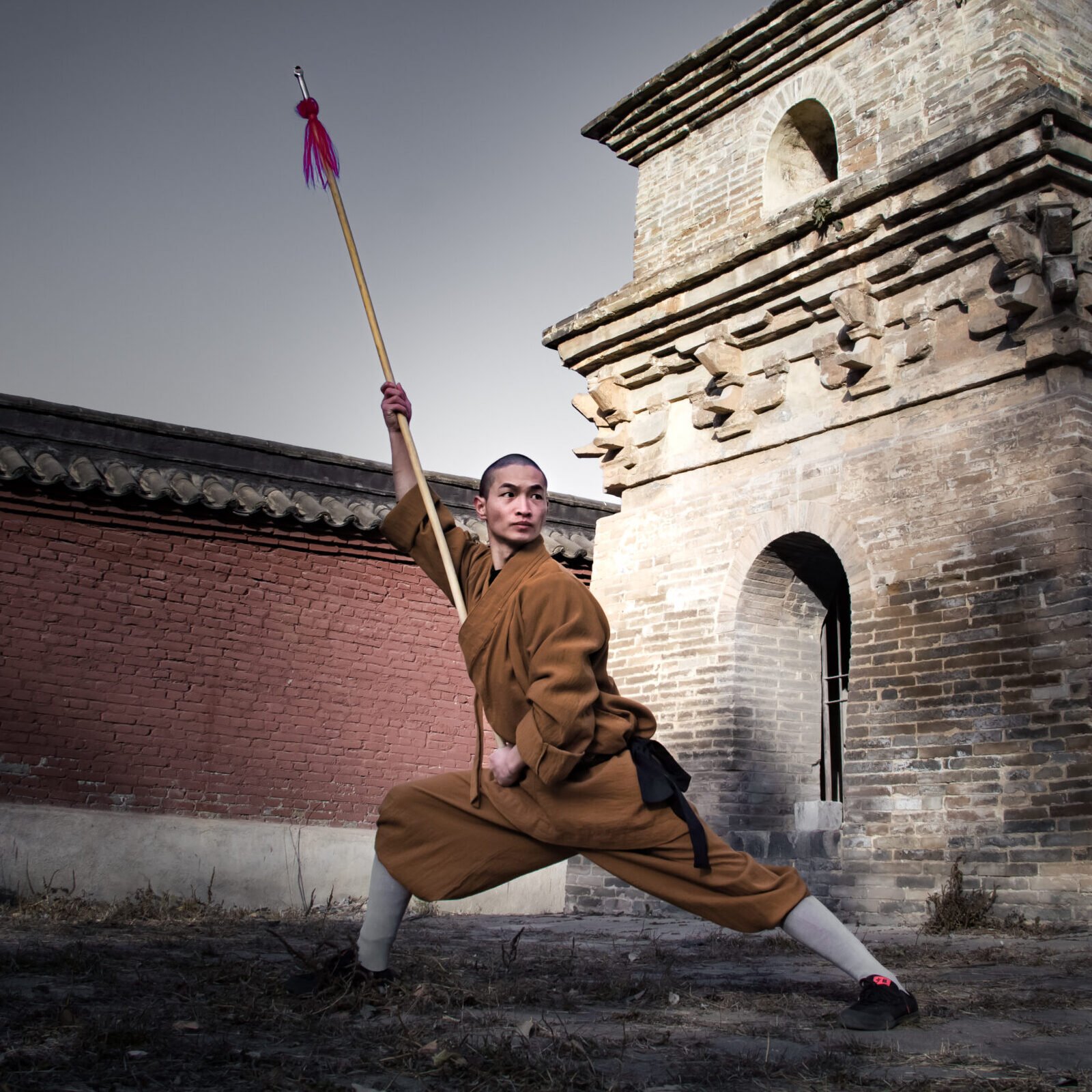
In ancient China, the spear was known as the “King of All Weapons”. It belongs to the category of long weapons. Its primary techniques include blocking, seizing, and thrusting, along with additional methods such as puncturing, striking, lifting, and deflecting. The characteristics of the spear technique are expressed as: “the spear thrusts in a straight line, strength is directed to the spear’s tip; when the spear is launched, it is as precise as an arrow, and when it is withdrawn, it moves like drawing silk.” The body movements are expansive, with variations that are unpredictable.
Shaolin Double Spears
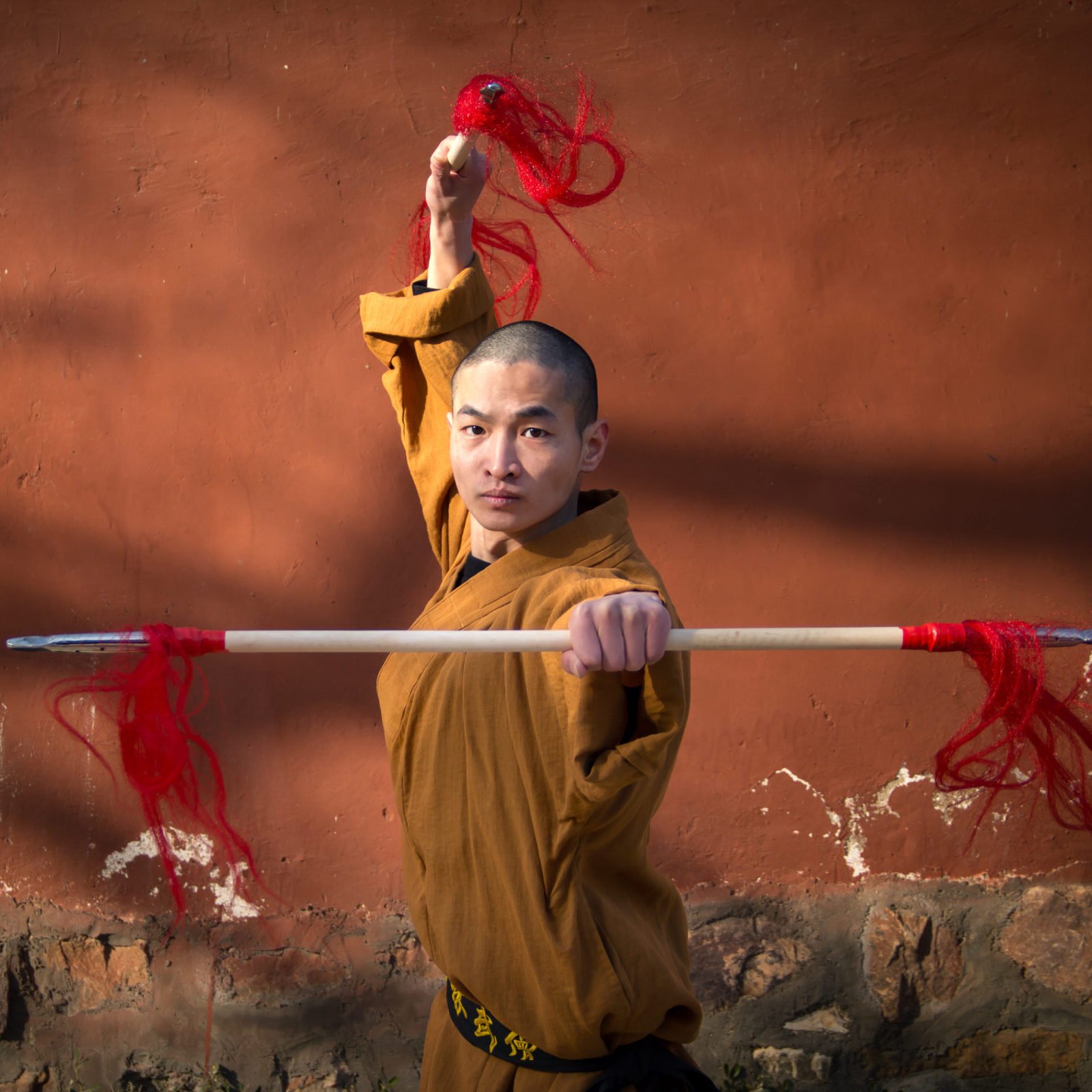
The Shaolin Double Spears were created by Shaolin monks for practical combat and self-defense, belonging to the category of short weapons. Due to their portability and practicality, they became widely used both on ancient battlefields and in folk martial arts. Each spear is about the length of the user’s arm, with a sharp tip and a lightweight shaft. The main techniques include thrusting, lifting, sweeping, blocking, and striking. As an important part of Shaolin Kung Fu, the art of the Shaolin Double Spears continues to be widely practiced and passed down both inside and outside the Shaolin Temple.
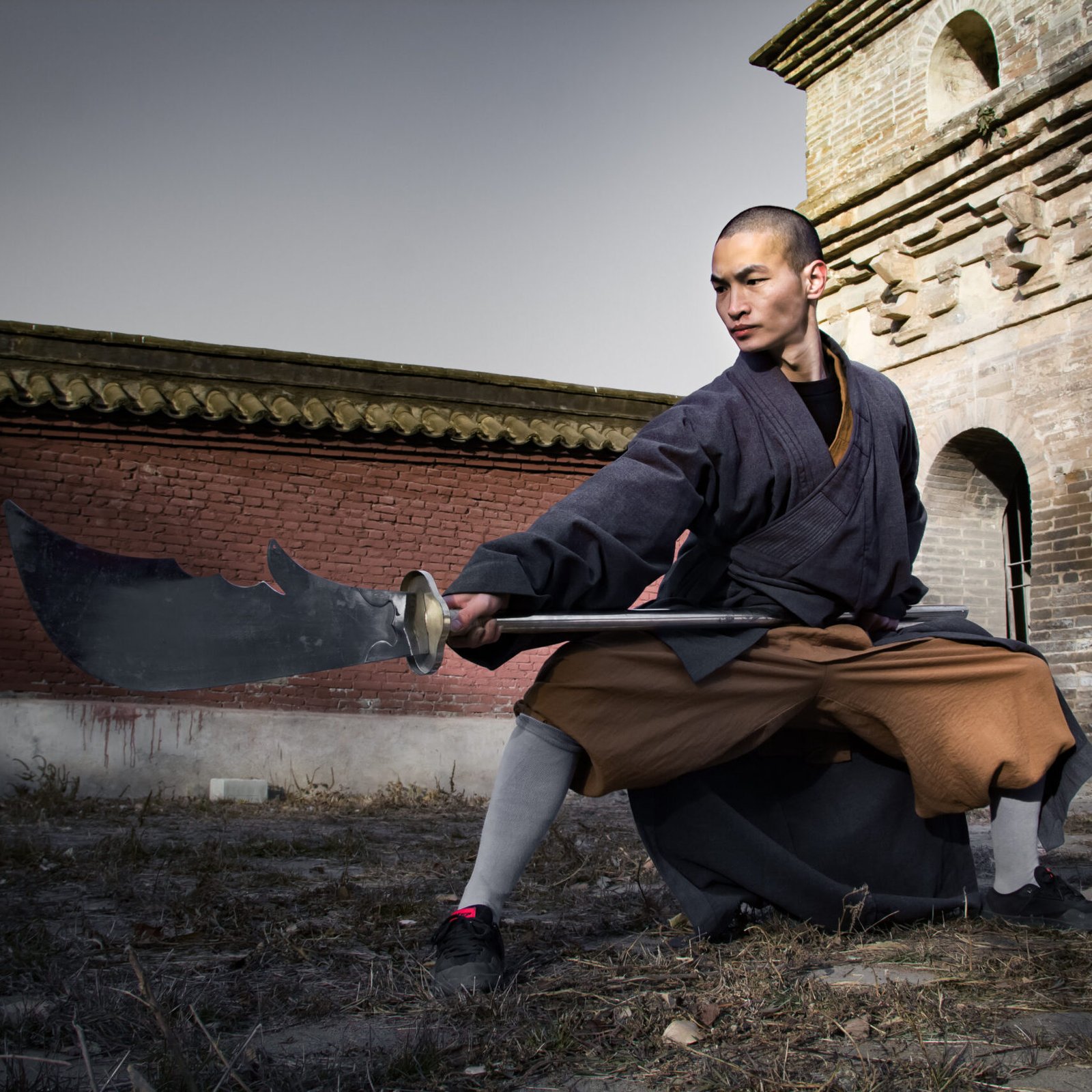
Shaolin Broadsword
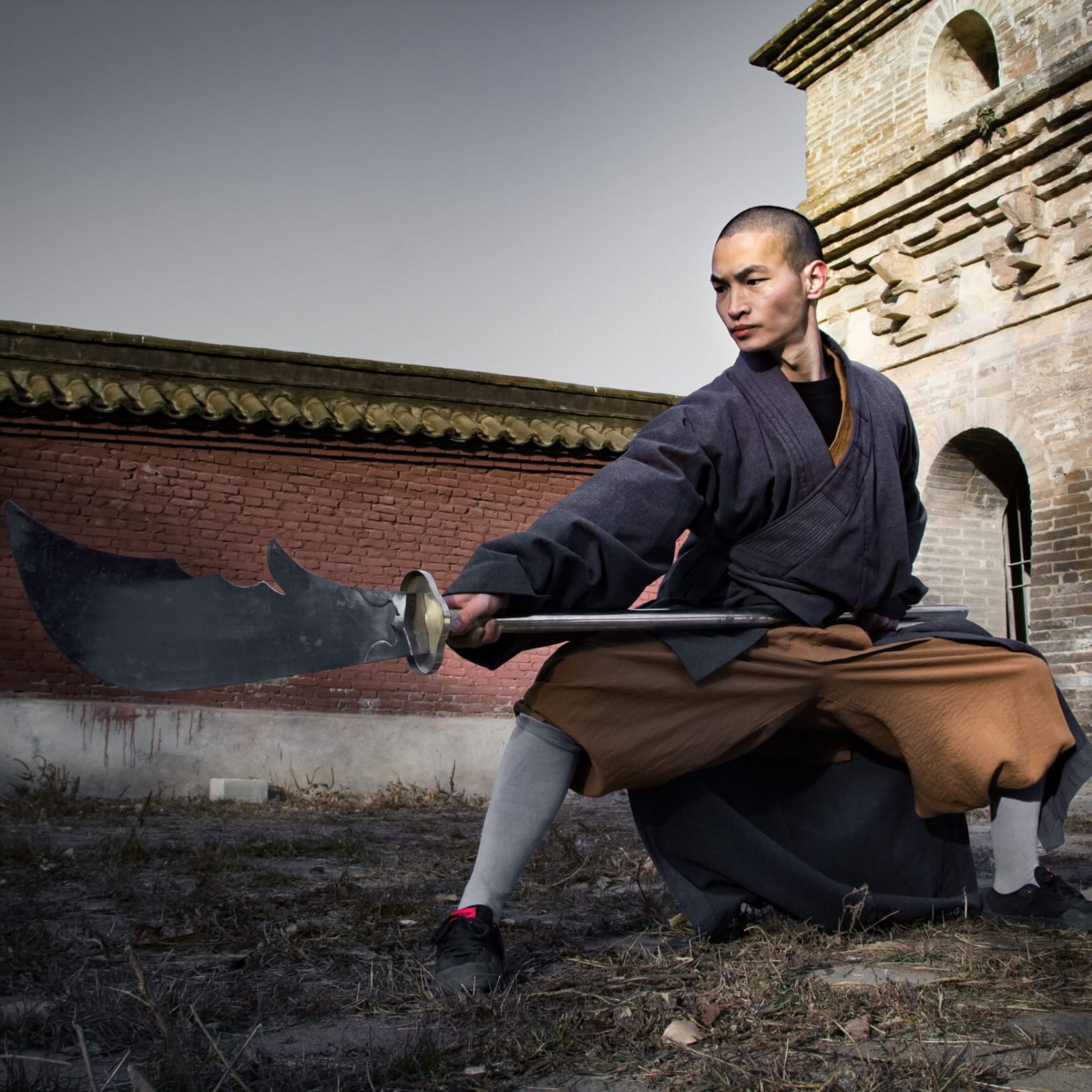
The Shaolin Broadsword is a traditional long weapon in Shaolin Kung Fu. It features a wide blade, a heavy blade head, and an extended handle suitable for two-handed use. Its main techniques include striking, slashing, lifting, sweeping, blocking, and thrusting. The movements are powerful and intense, allowing both offensive and defensive applications. Because of its tremendous striking power, it has been honored later on with the title “Commander of All Weapons.”
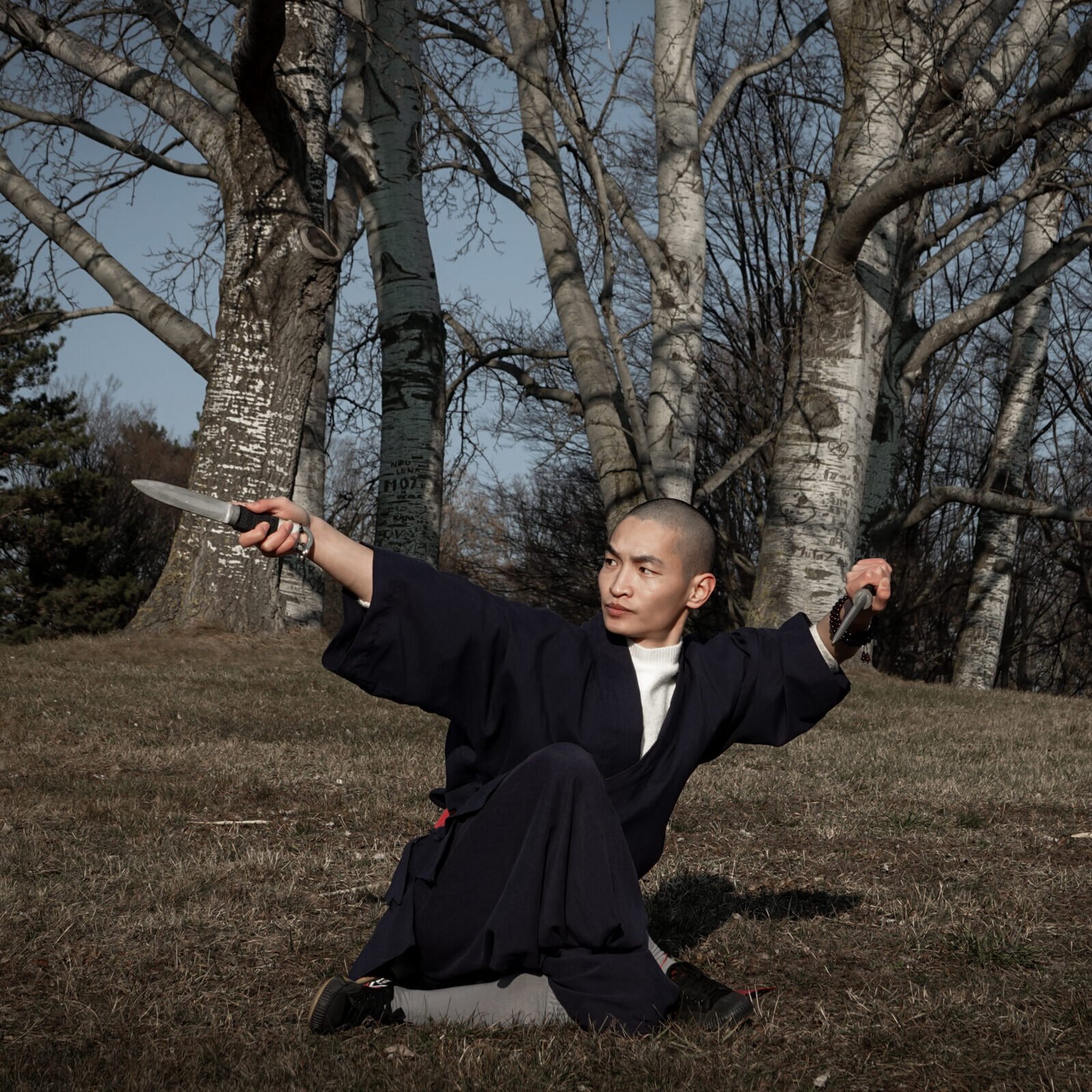
Shaolin Double Daggers
The Shaolin Double Daggers are a type of short weapon in traditional Shaolin Kung Fu, renowned for their agility, speed, and fierce stabbing techniques. Though small in size, the daggers have a extremely high striking power and are well-suited for close-combat and covert attacks. In Shaolin Kung Fu, the double daggers are combined with fist techniques, kicking methods, and grappling skills to form a unique offensive and defensive system.
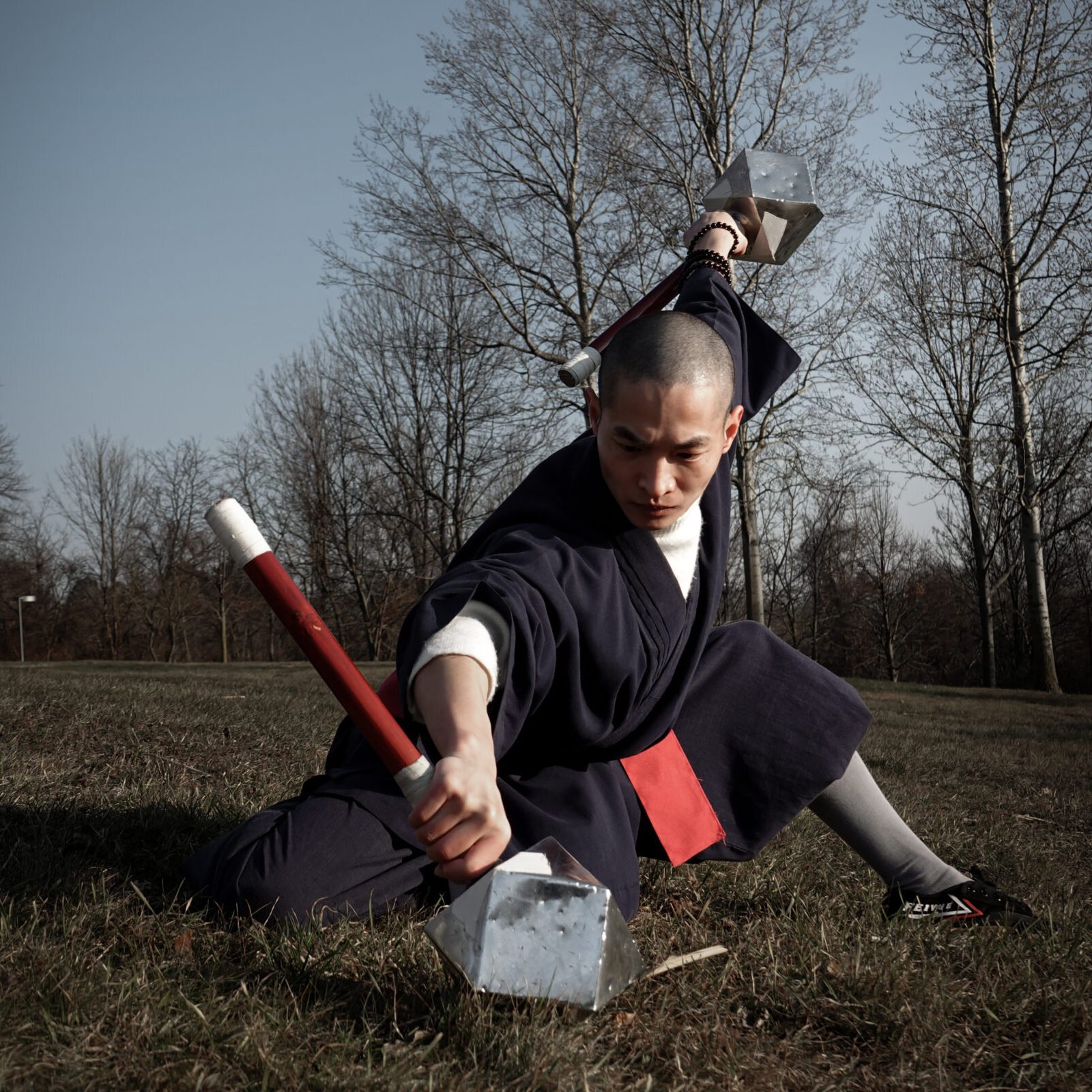
Shaolin Double Hammers
The Shaolin Double Hammers are a traditional weapon in Shaolin Kung Fu and belong to the short weapons. Each hand wields a hammer, with heads typically made of metal and varying in shape, e.g. round, or octagonal. The handles are relatively short, making them suitable for close-range combat. The primary techniques include smashing, sweeping, lifting, and blocking. The use of the double hammers requires great arm and wrist strength, as well as the skill of agile body movement and footwork. In ancient battlefields, the double hammers were widely used and, due to their tremendous destructive power, were praised as “armor-breaking weapons.”
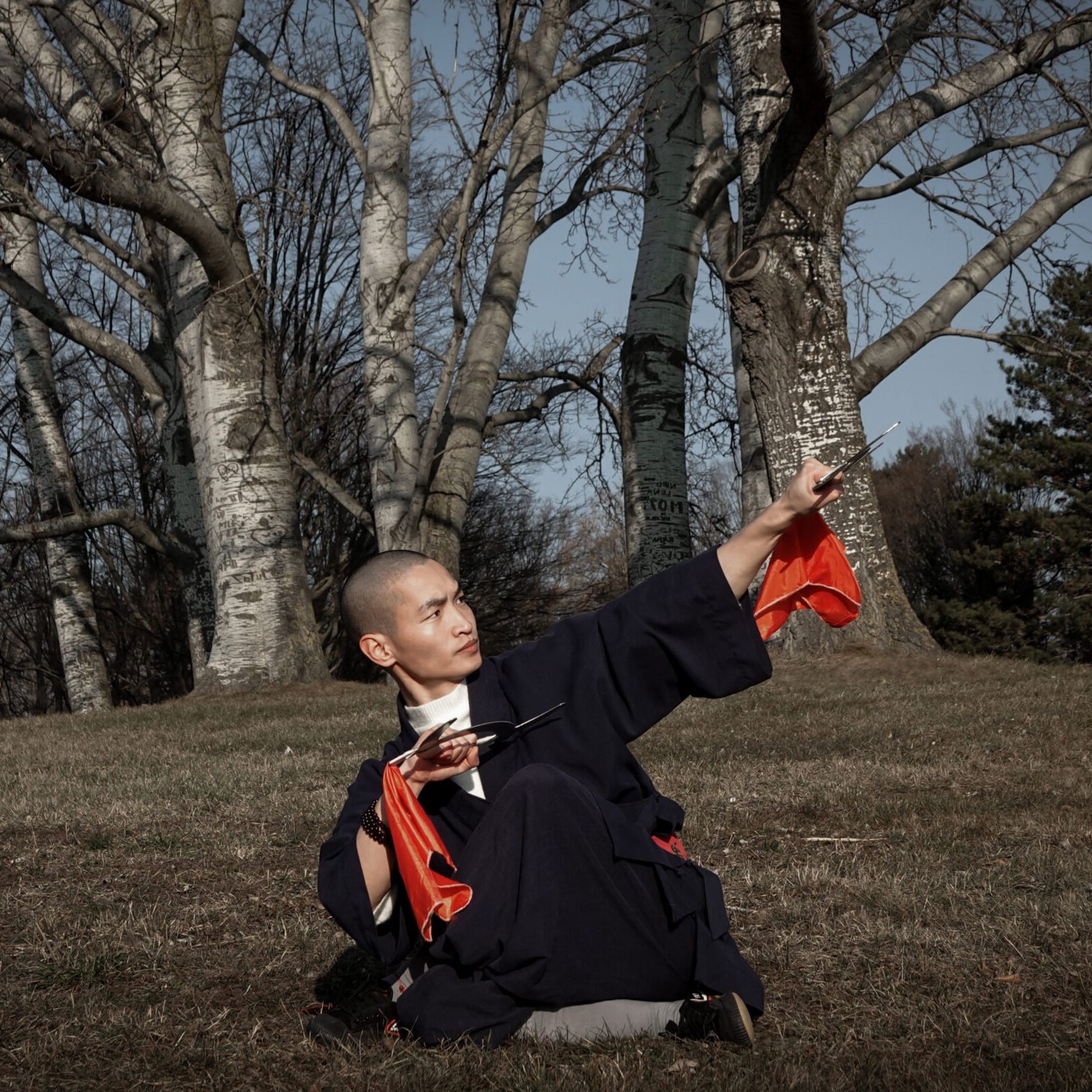
Shaolin Halfmoon Daggers
The Shaolin Halfmoon Daggers (lit. Mother-and-Child Axes) are a unique type of short double weapon within the Shaolin weapon-system. It consists of two parts: the larger “Mother Axe” and the smaller “Child Axe”. This weapon is primarily used for close-range combat and combines various techniques such as chopping, hooking, entangling, lifting, and thrusting. Its attacks are extremely flexible and diverse, making it one of the commonly used weapons by Shaolin monks for practical combat.
Shaolin Staff
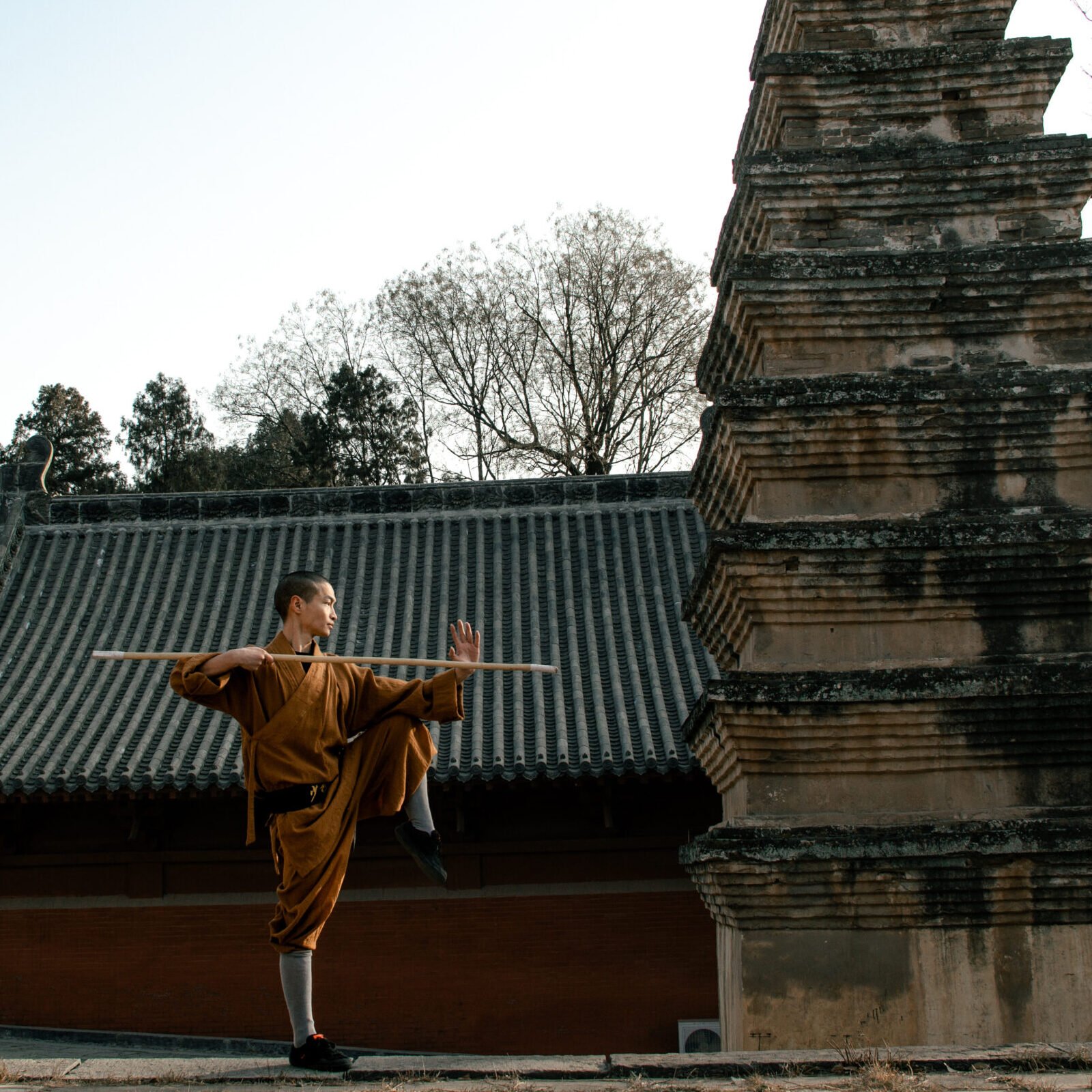
The Shaolin staff is the most renowned weapon in Shaolin Kung Fu. Not only do the monks of the Shaolin Temple revere it as the “ancestor of all weapons,” but people from all walks of life honor the Shaolin staff as well. The staff techniques primarily include sweeping, deflecting, blocking, thrusting, lifting, striking, and jabbing. Training in staff techniques is intense, with a clear rhythm, and it requires speed, courage, and dynamic movements. Among the most famous forms are the “Yin Shou staff”, the “Fire staff”, and the “Kinnara staff”.
Shaolin Double Staffs
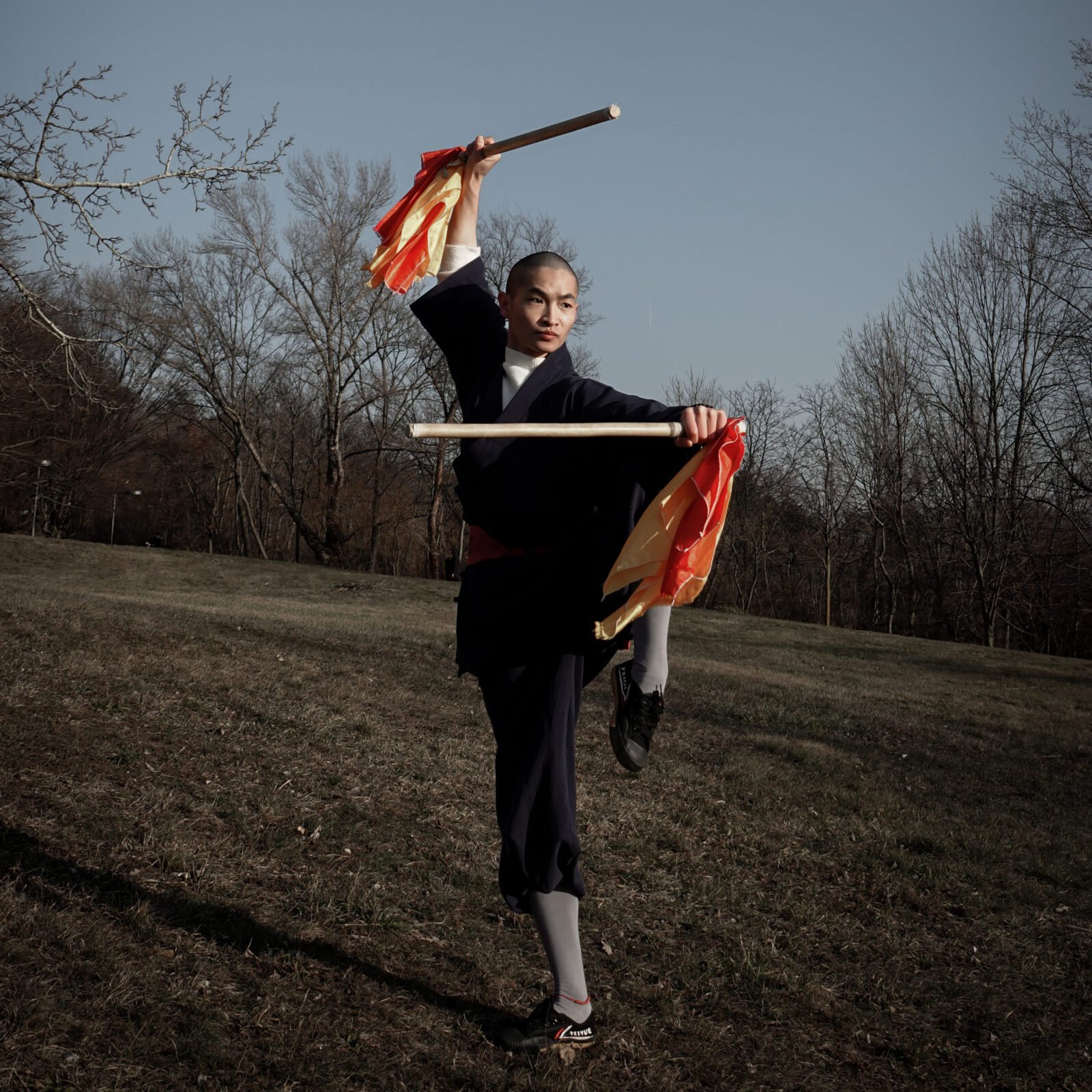
The Shaolin Double Staffs are a type of short weapon within the Shaolin weapon-system. They are known for their combination of offense and defense as well as their versatile techniques. Compared to the single staff, the double staffs offer greater flexibility and striking speed, allowing simultaneous attack and defense, making it difficult for opponents to counter and defend themselves. Through long-term combat experience and training, Shaolin monks integrated fist techniques, footwork, and body movements, out of which a unique weapon form was developed, making the double staff an important part of the Shaolin weapon-system.
Shaolin Three-Section Staff
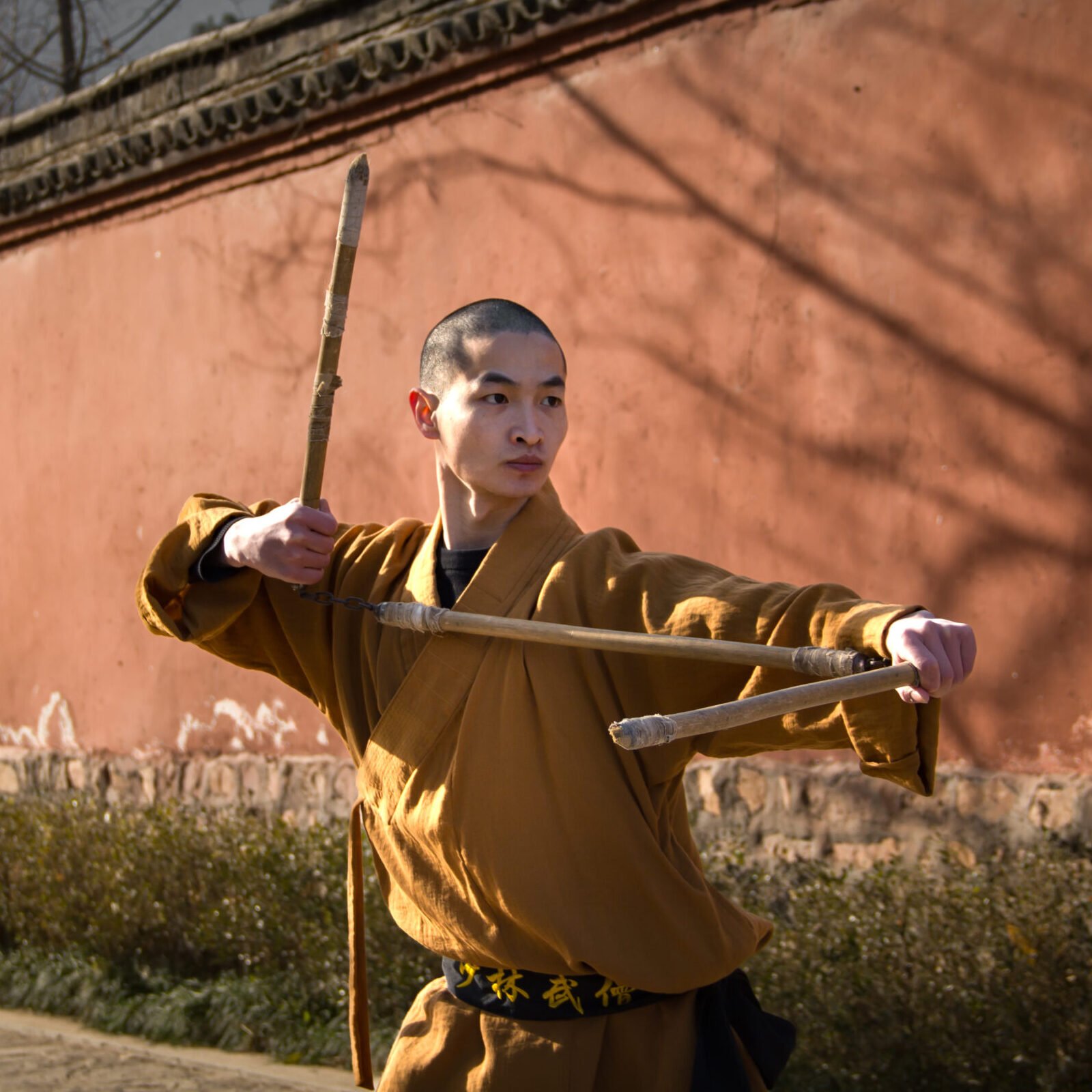
Shaolin Three-Section Staff belongs to the flexible weapons in the Shaolin weapon system. It is composed of three short staffs connected by iron chains or leather straps. It combines the characteristics of various weapons such as the staff, whip, hammer, and rope enabling both powerful slashing and flexible wrapping attacks. It offers a balanced combination of offense and defense and is praised as a classic weapon that employs both “soft and hard” tactics.
Shaolin Saber
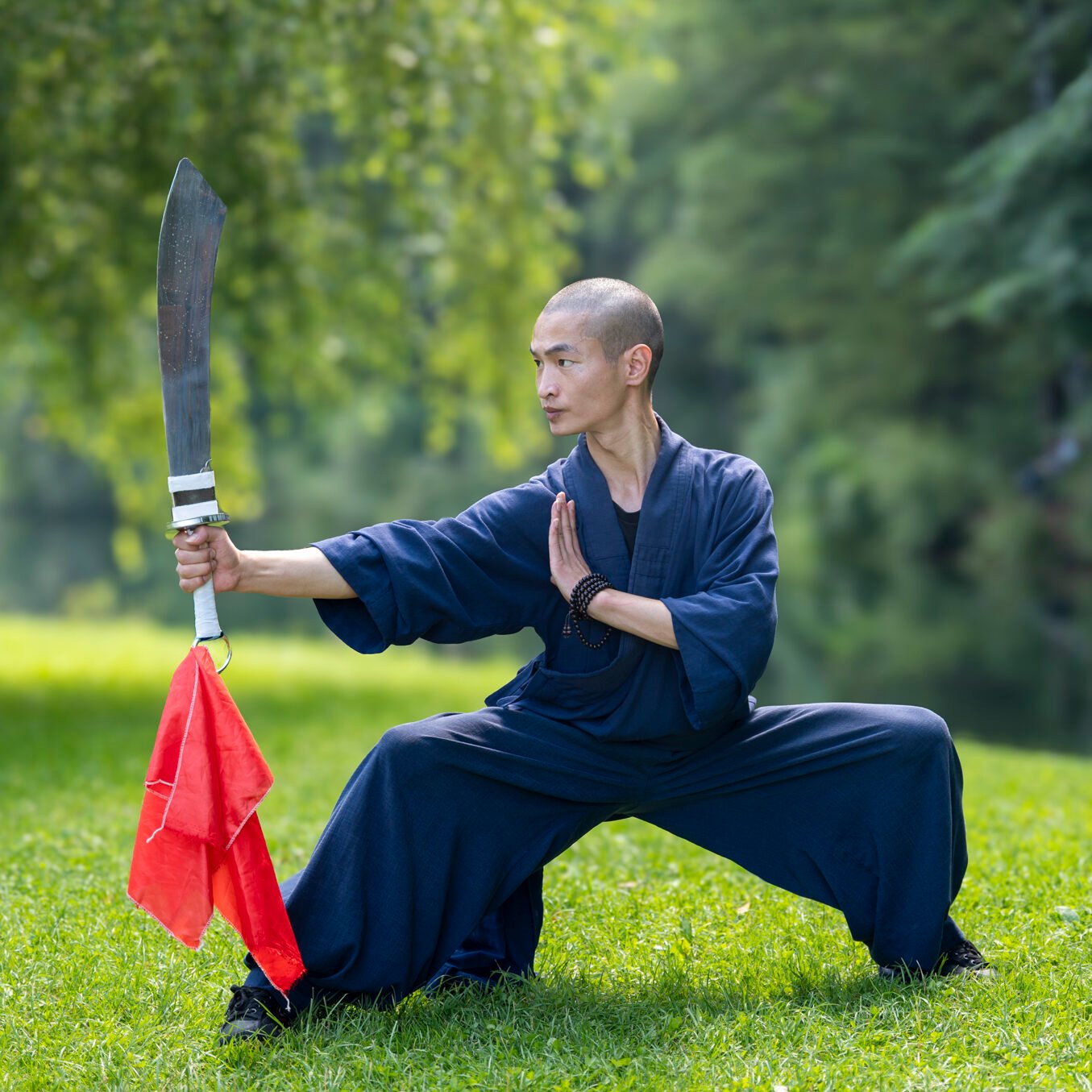
The Shaolin saber was originally one of the most widely used weapons in both folk martial arts and the military. The Shaolin saber system began to take shape during the mid to late Ming Dynasty. By the end of the Ming Dynasty, as Shaolin Kung Fu developed and warrior monks took part in battles, the saber became one of their most frequently used weapons by the Shaolin warrior monks.
The system’s techniques include wrapping and circling motions around the head, combined with turning slashes and sweeping strikes, as well as thrusting, lifting, chopping, blocking, and throwing — together forming a complete saber-fighting system. After the Qing Dynasty, the number of Shaolin saber forms increased, and the techniques were further refined. There is a saying that “The Shaolin saber is like a fierce tiger,” describing the weapon’s powerful and brave nature when wielded in combat.
Shaolin Double Sabers
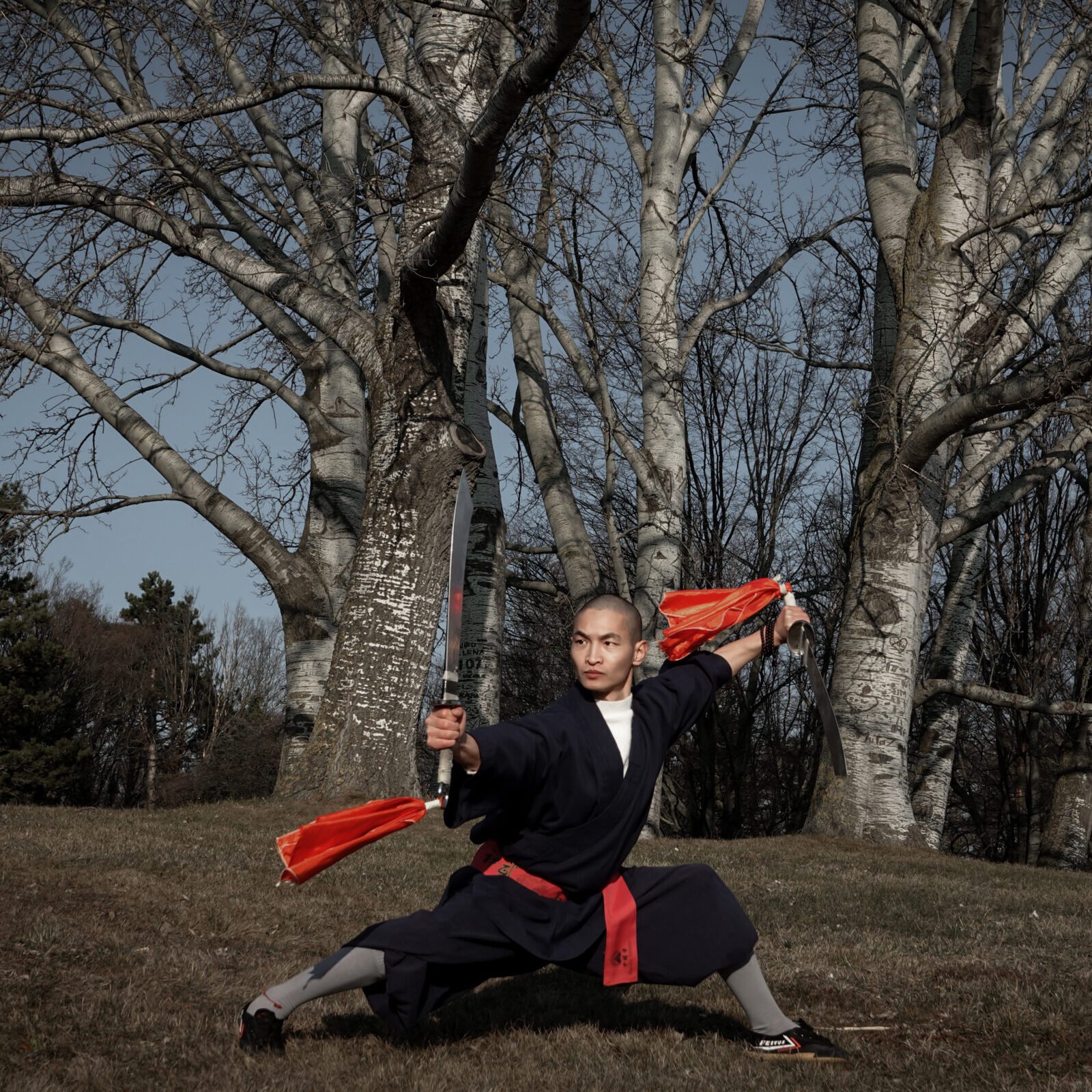
The Shaolin Double Sabers are a dual-weapon technique within the Shaolin weapon system. They inherit the methods of the single saber while enhancing both attack frequency and defensive capability, making them more dynamic and unpredictable in combat. The form emphasizes coordination between both hands, complementarity between left and right, agile footwork, and rapid attack combinations. Its techniques are characterized by being as “swift as the wind, fierce as the tiger, and powerful as thunder.”
Shaolin Shield-Saber
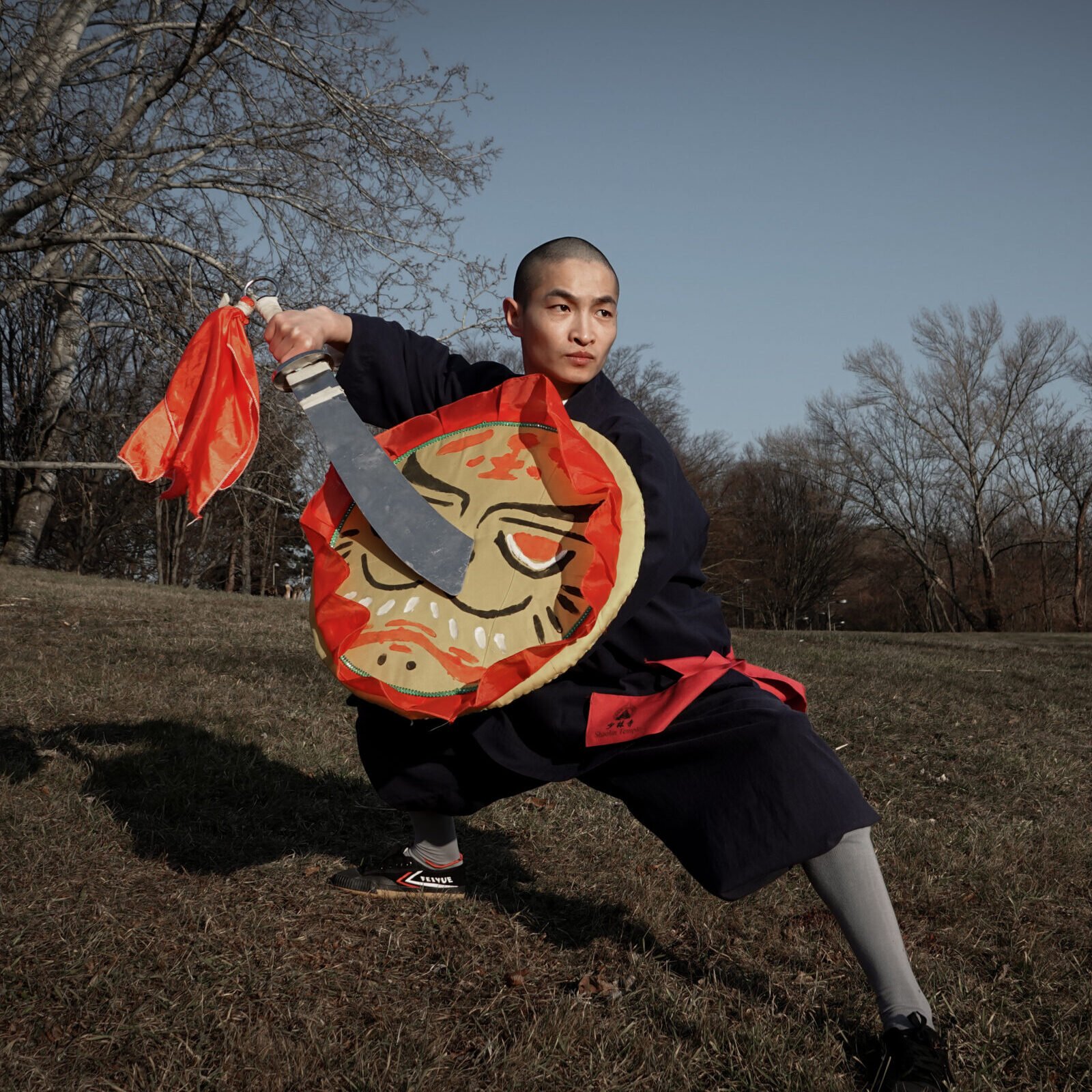
The Shaolin shield and saber technique can be traced back to the Ming Dynasty during times of warfare, when Shaolin monks were recruited by the imperial Ming regime to help repel invaders. The invaders often wielded Katana swords and attacked with great speed and ferocity. To counter these aggressive assaults, the Shaolin warrior monks developed a combat method that combined the use of a shield and a saber. The Shaolin shield and saber is a unique weapon combination that integrates both defense and offense. The shield is used for blocking and controlling the opponent, while the saber delivers rapid counterattacks. This makes it difficult for the enemy to break through the line of defense while simultaneously being confronted with fast attacks when he tries to counter.
Shaolin Sword
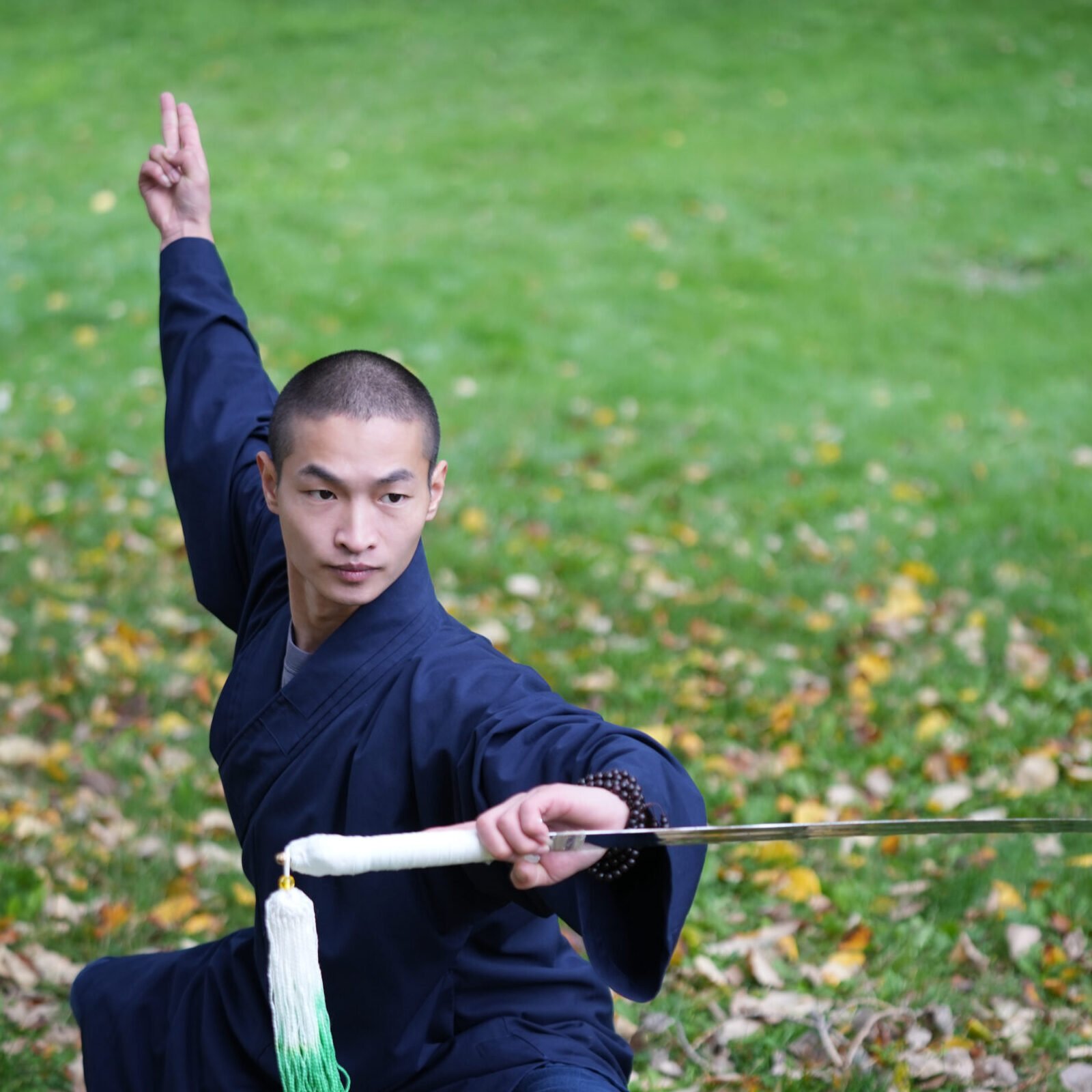
The Shaolin sword is one of the weapons most frequently used by Shaolin monks and is among the most representative of the traditional Eighteen Shaolin Weapons. It is characterized by a balance of hardness and softness, lightness and agility, and the makes use of the skill to overcome brute strength with finesse. Unlike the saber, which emphasizes power and ferocity, Shaolin sword techniques focus on the coordination of body and footwork, highlighting circular and fluid movements and the combination of real and feigned attacks. The sword follows the body, and the body follows the mind. This weapon emphasizes flexibility and adaptability by controlling the raw strength of the opponent with small and dynamic attacks. The sword techniques include both swift jabs and elegant spinning slashes, agile steps and body movement to create more deceptive and highly variable attacks.
Shaolin Double Swords
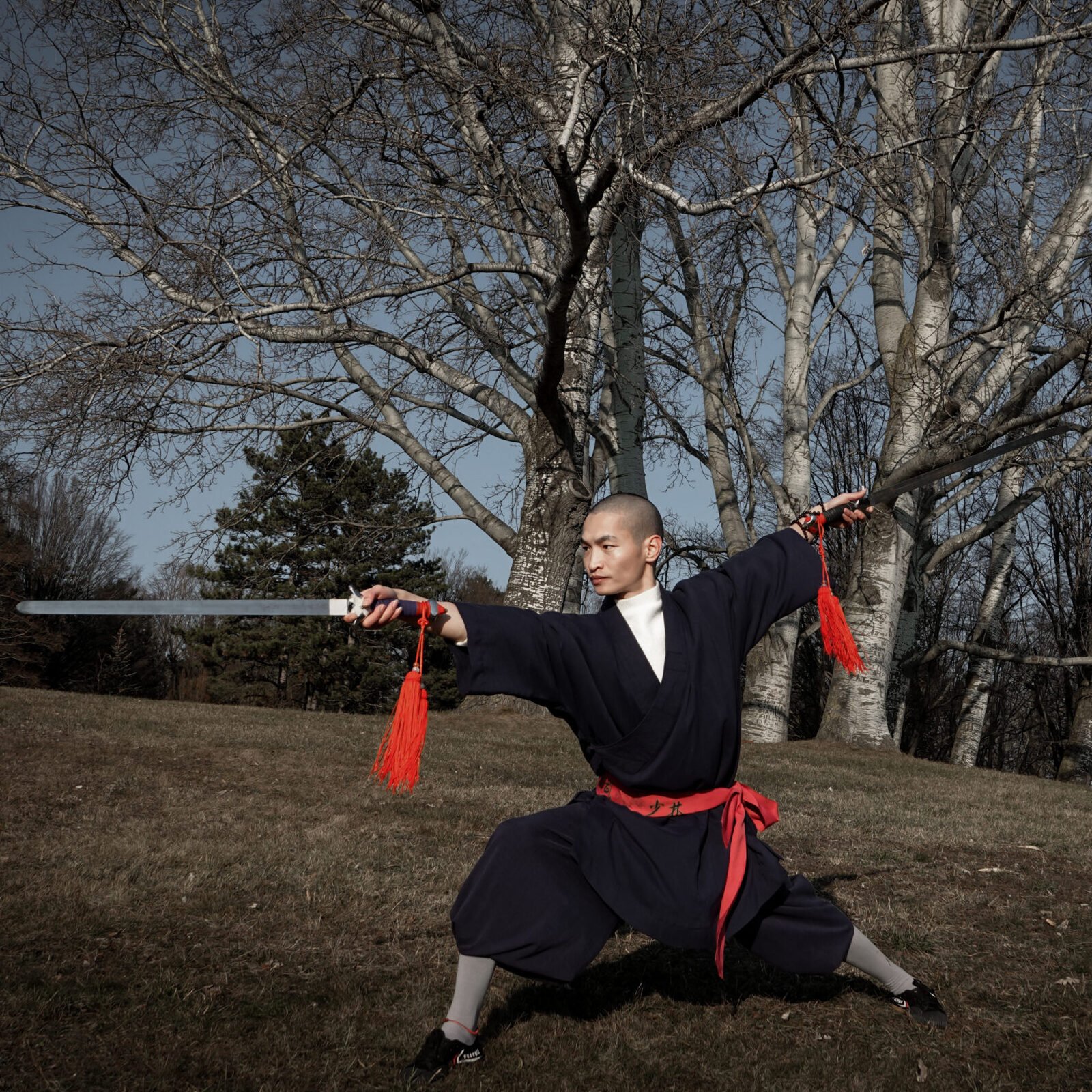
The Shaolin Double Swords are a dual-weapon technique within the Shaolin weapon system. Based on the fundamentals of single sword techniques, the double swords form additionally and especially emphasizes the coordinated use of both hands, connecting offense and defense. One sword is used for attacking while the other defends, switching rapidly to form a fluid system of offense and defense. In battle, the Shaolin Double Swords emphasize the unity of body and sword, with fast attacks and quick defenses. The agile footwork combined with continuous attacks with both swords makes it difficult for the opponent to find weaknesses in the attacks.
Shaolin Crescent Spade
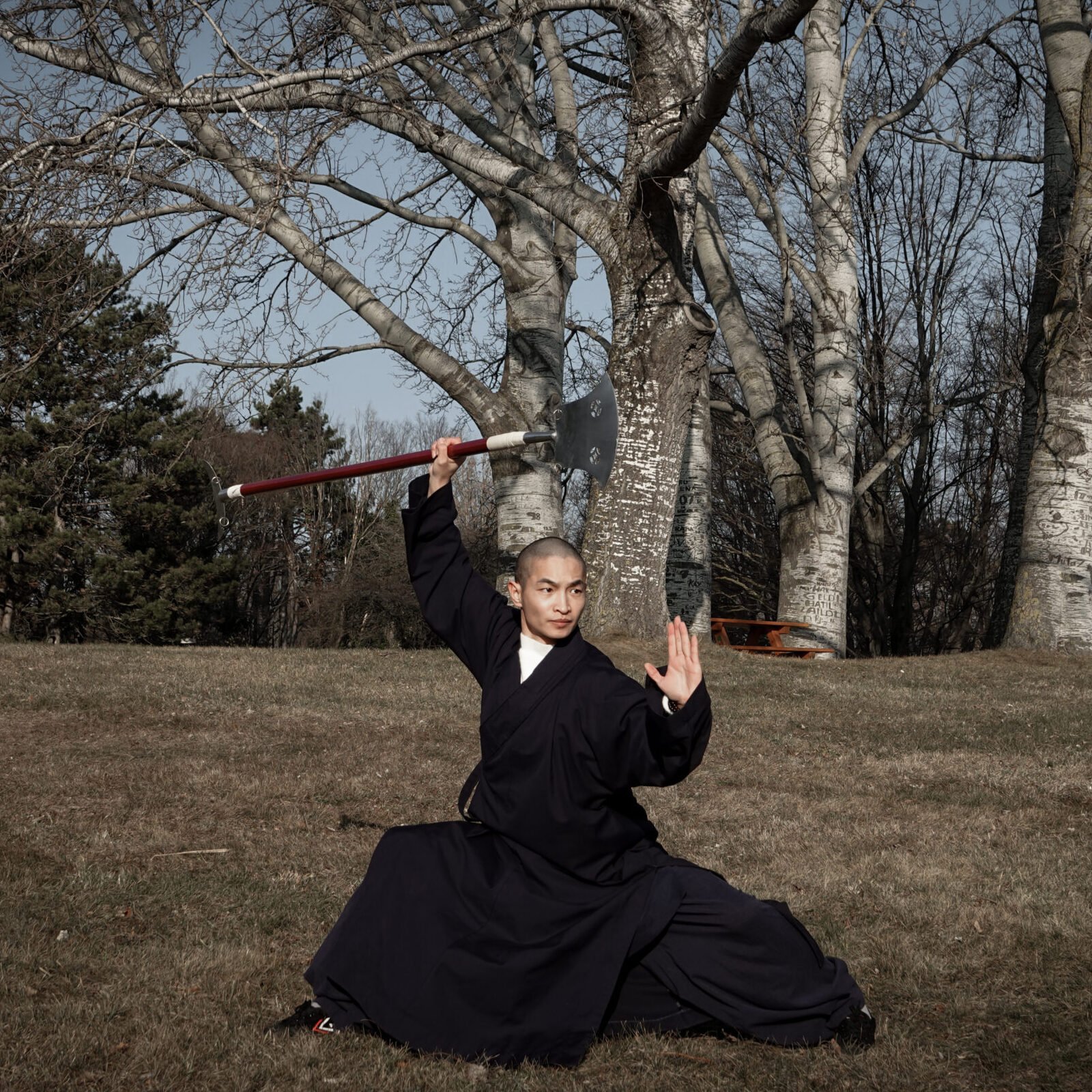
The Shaolin Crescent Spade belongs to the category of long weapons. According to the Shaolin Weapon Manual, during the Yuan Dynasty, Monk Huiju was a Master in wielding the spade. He often practiced with it in the deep quiet of the night, using movements of Shaolin Kung Fu. On several occasions, when thieves attempted to scale the monastery walls and rob the temple, he used the spade to defend himself and successfully repelled the attackers each time. Afterwards, he recorded the combat techniques used in these encounters, developing them into a complete form that was passed down through generations and greatly admired among Shaolin monks. The techniques of the Crescent Spade include striking, lifting, hooking, jabbing, sweeping, and spinning. These are combined with techniques from the Shaolin spear, staff, and saber, forming a distinctive combat system.
Shaolin Nine-Section Whip
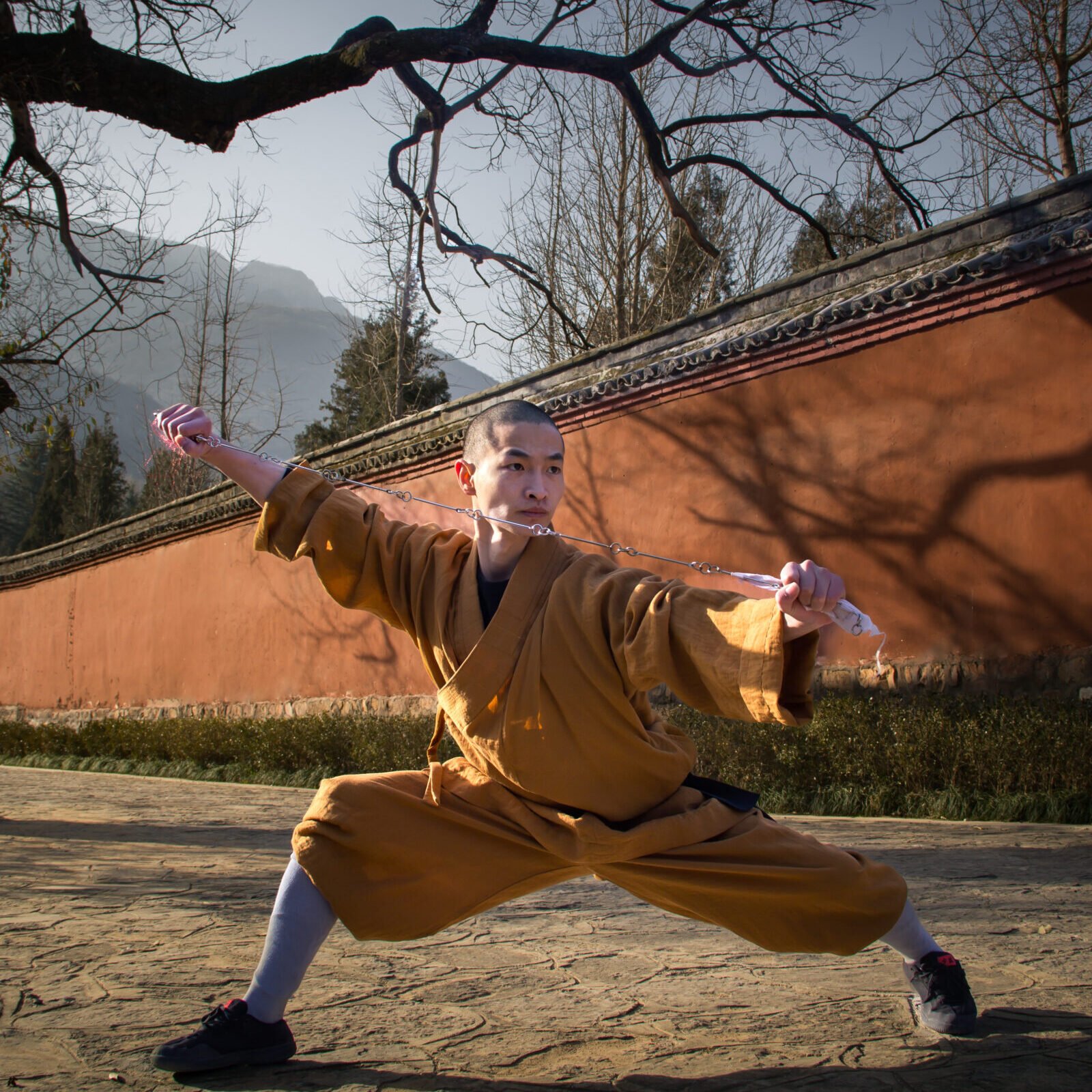
The Shaolin Nine-Section Whip approximately originated during the Song Dynasty. According to the „Shaolin Quanpu“, during that period, the eminent monk Fu Ju of Shaolin Temple sought to develop Shaolin martial arts and improve the fighting skills of Shaolin monks. He invited eighteen martial arts masters from across the country to Mount Song’s Shaolin Temple to exchange their knowledge, and it was during this time that the Nine-Section Whip was introduced to the Shaolin Temple.
Through study and practice by Shaolin monks over centuries, it gradually evolved into a distinctive and highly practical weapon within the Shaolin weapon system. Its fundamental techniques include swinging the whip to strike the opponent’s face, sweeping the whip to attack and disrupt the opponent’s lower body, and entangling the whip by using its flexible body to wrap around the opponent’s weapon or limbs, throwing them off balance. It also includes spinning attacks, which are wide rotational motions that generate great destructive force, and lastly binding techniques that trap the opponent’s weapon or body, preventing any counterattack.
Shaolin Double Nine-Section Whip
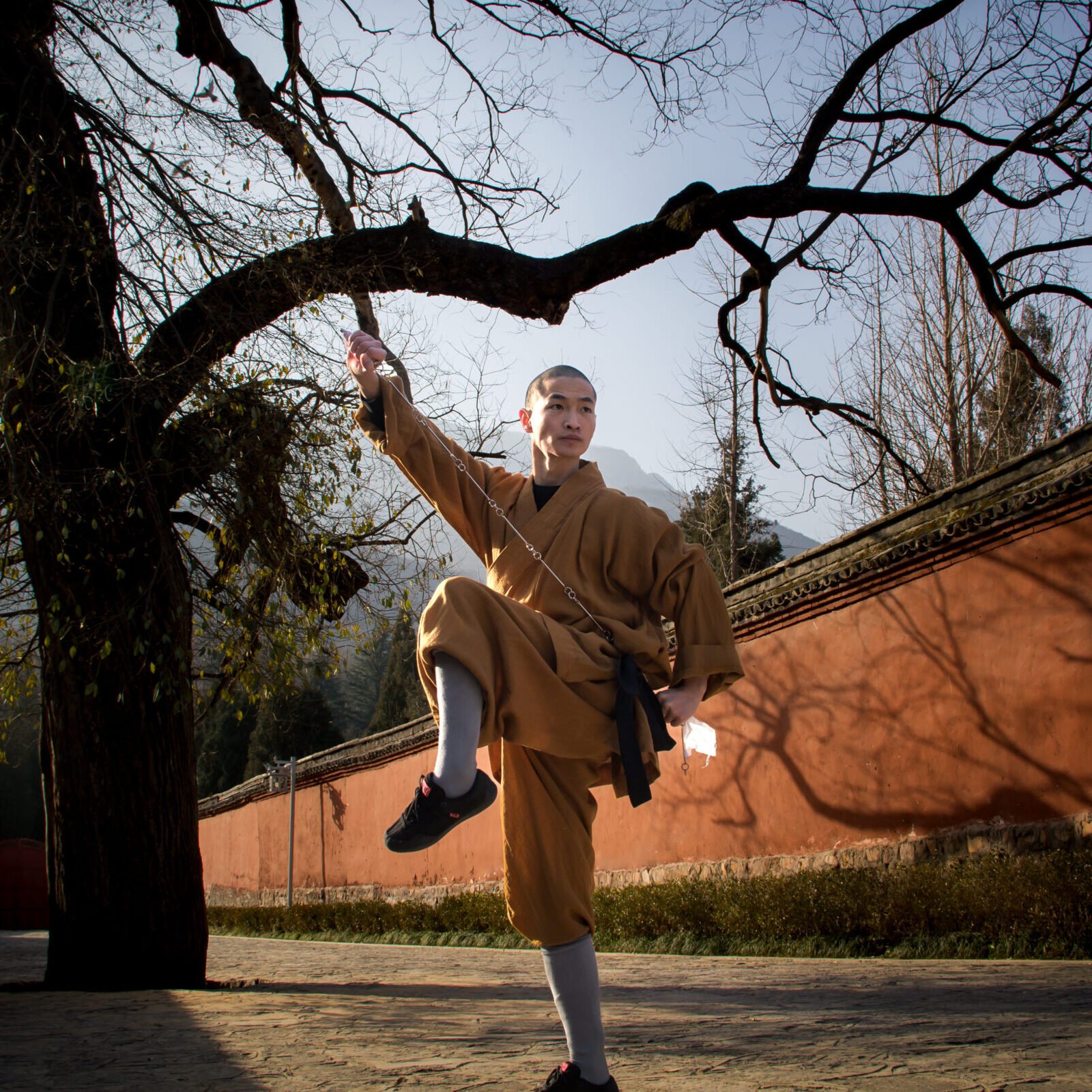
The Shaolin Double Nine-Section Whip is an advanced weapon technique within the Shaolin whip system. It is based on the single Nine-Section Whip and also includes skills such as swinging the whip to strike the opponent’s face, sweeping the whip to attack and destabilize the opponent’s lower body, entangling the whip to wrap around the opponent’s weapon or body and throw them off balance, spinning the whip in wide, circular attacks that generate great destructive force, and binding the whip to trap the opponent’s weapon or body, preventing counterattacks. Compared to the single Nine-Section Whip, the use of the double version is significantly more difficult, requiring a high degree of coordination between both hands.
Shaolin Da Mo Staff
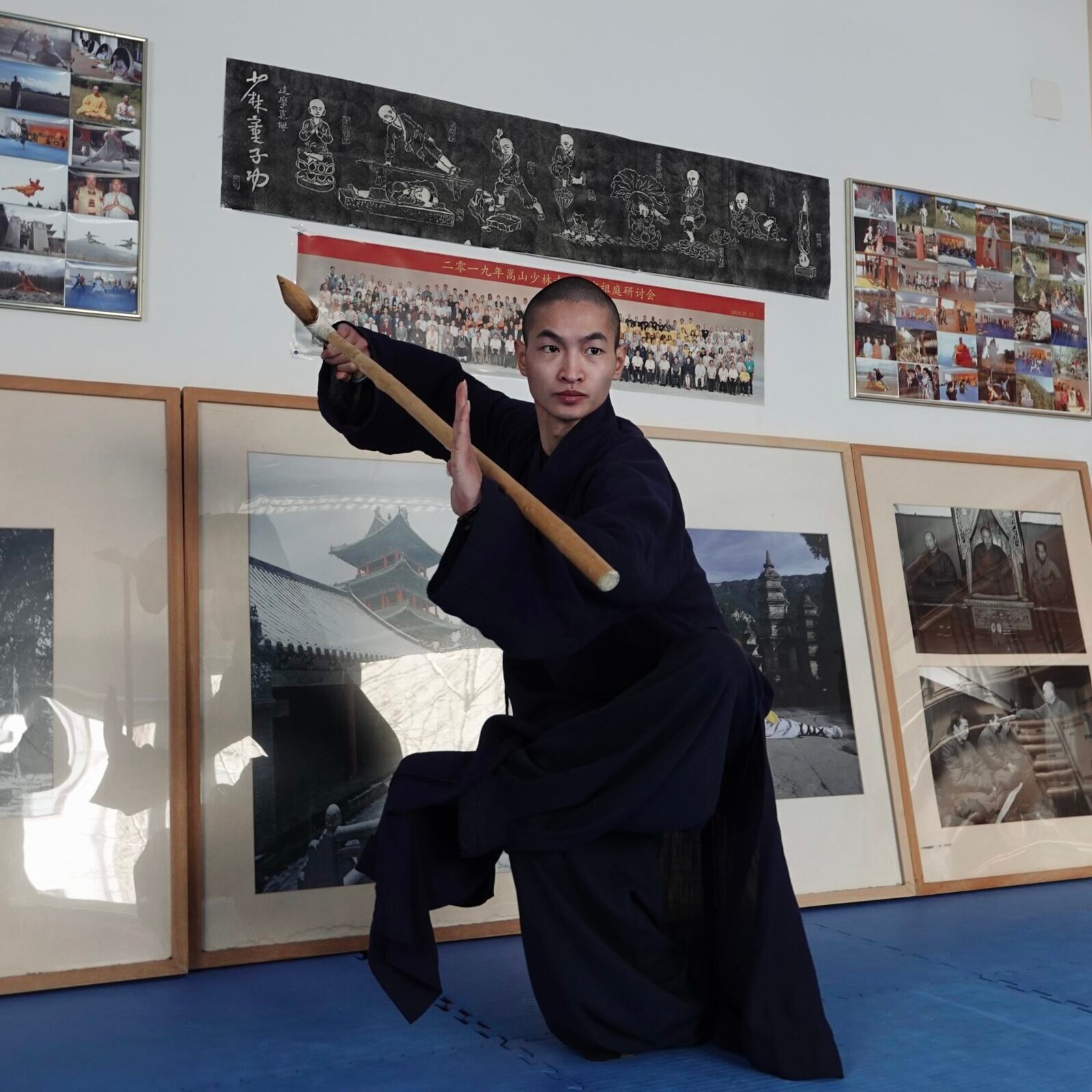
The Shaolin Da Mo Staff (crutch) is a unique short weapon, shorter than the standard staff. It is known for its compact size, agility, practicality, and versatility in both offense and defense, making it especially effective in close combat. Its techniques are derived from traditional Shaolin staff methods, with core movements including striking, sweeping, jabbing, thrusting, hooking, and pressing. The Shaolin Da Mo staff is a highly practical weapon for self-defense.
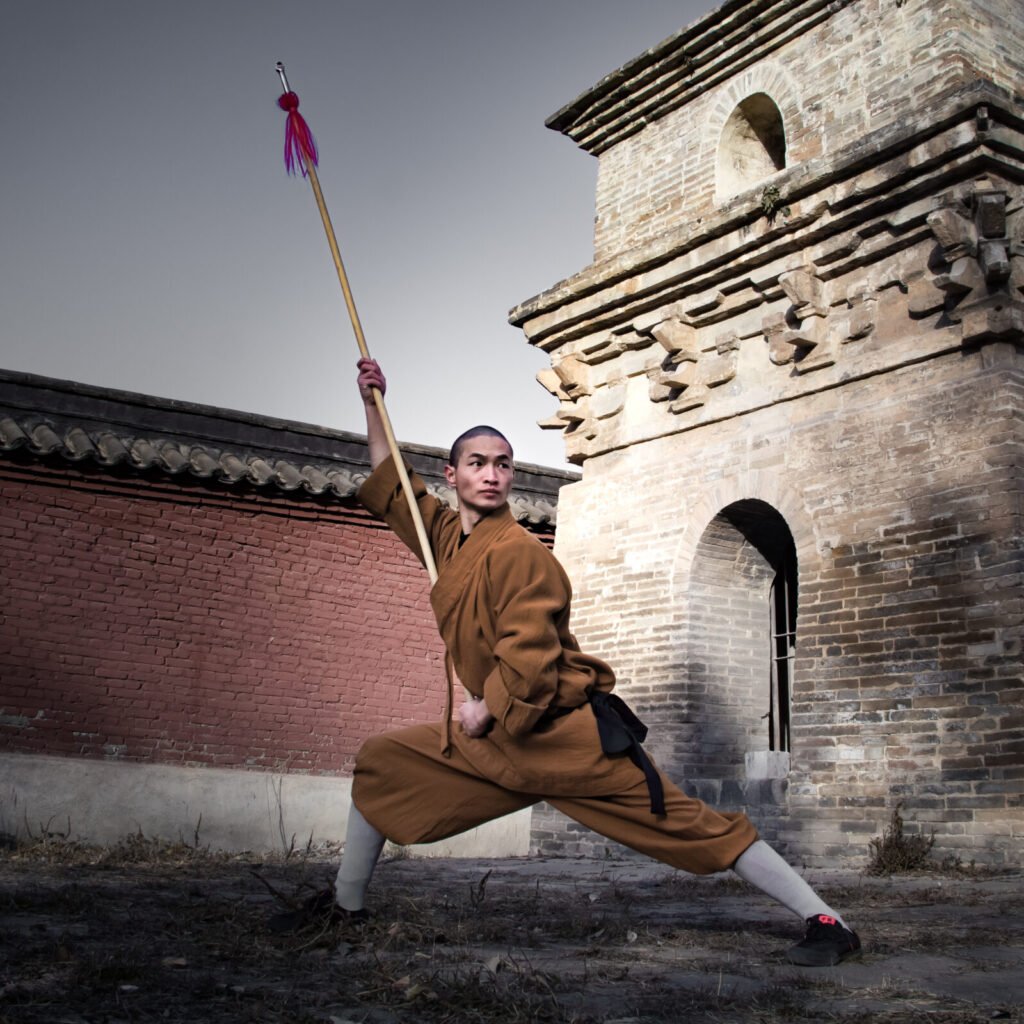
Shaolin Spear
In ancient China, the spear was known as the “King of All Weapons”. It belongs to the category of long weapons. Its primary techniques include blocking, seizing, and thrusting, along with additional methods such as puncturing, striking, lifting, and deflecting. The characteristics of the spear technique are expressed as: “the spear thrusts in a straight line, strength is directed to the spear’s tip; when the spear is launched, it is as precise as an arrow, and when it is withdrawn, it moves like drawing silk.” The body movements are expansive, with variations that are unpredictable.
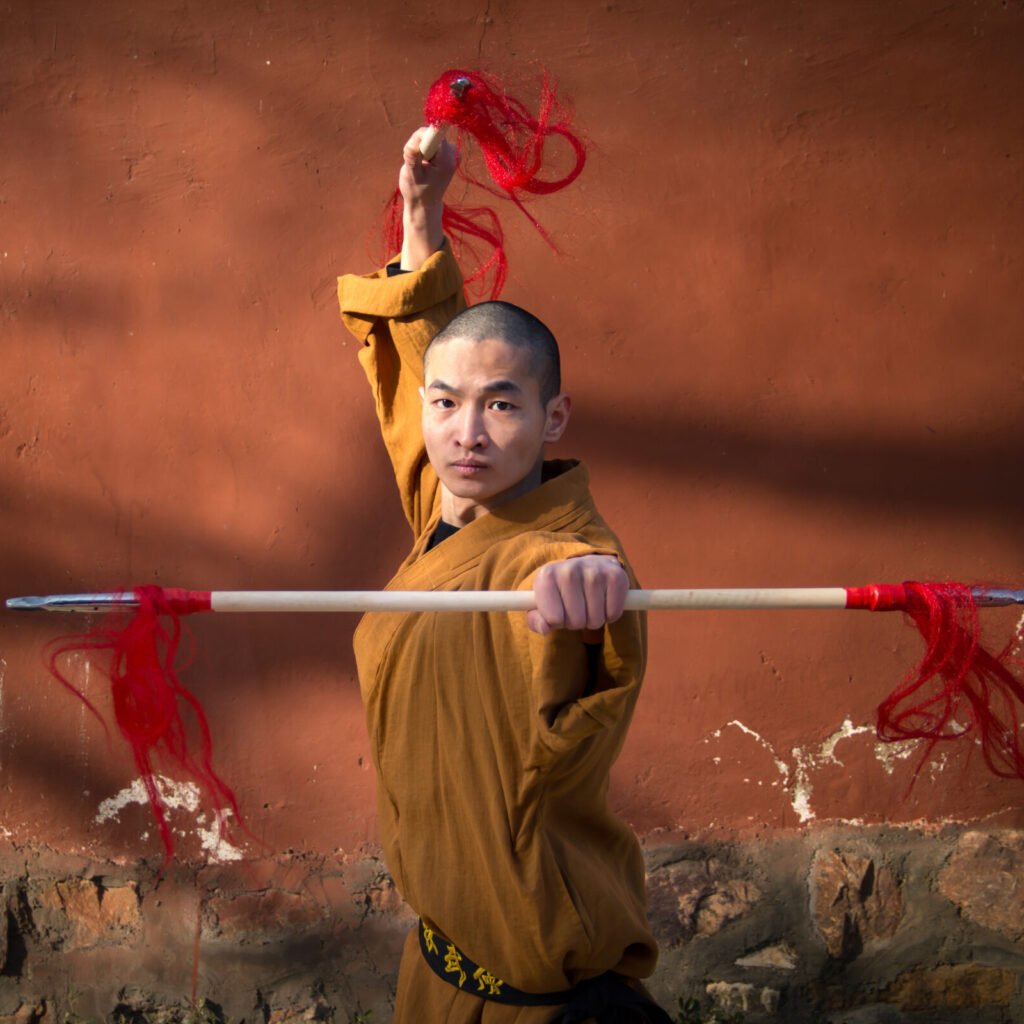
Shaolin Double Spears
The Shaolin Double Spears were created by Shaolin monks for practical combat and self-defense, belonging to the category of short weapons. Due to their portability and practicality, they became widely used both on ancient battlefields and in folk martial arts. Each spear is about the length of the user’s arm, with a sharp tip and a lightweight shaft. The main techniques include thrusting, lifting, sweeping, blocking, and striking. As an important part of Shaolin Kung Fu, the art of the Shaolin Double Spears continues to be widely practiced and passed down both inside and outside the Shaolin Temple.
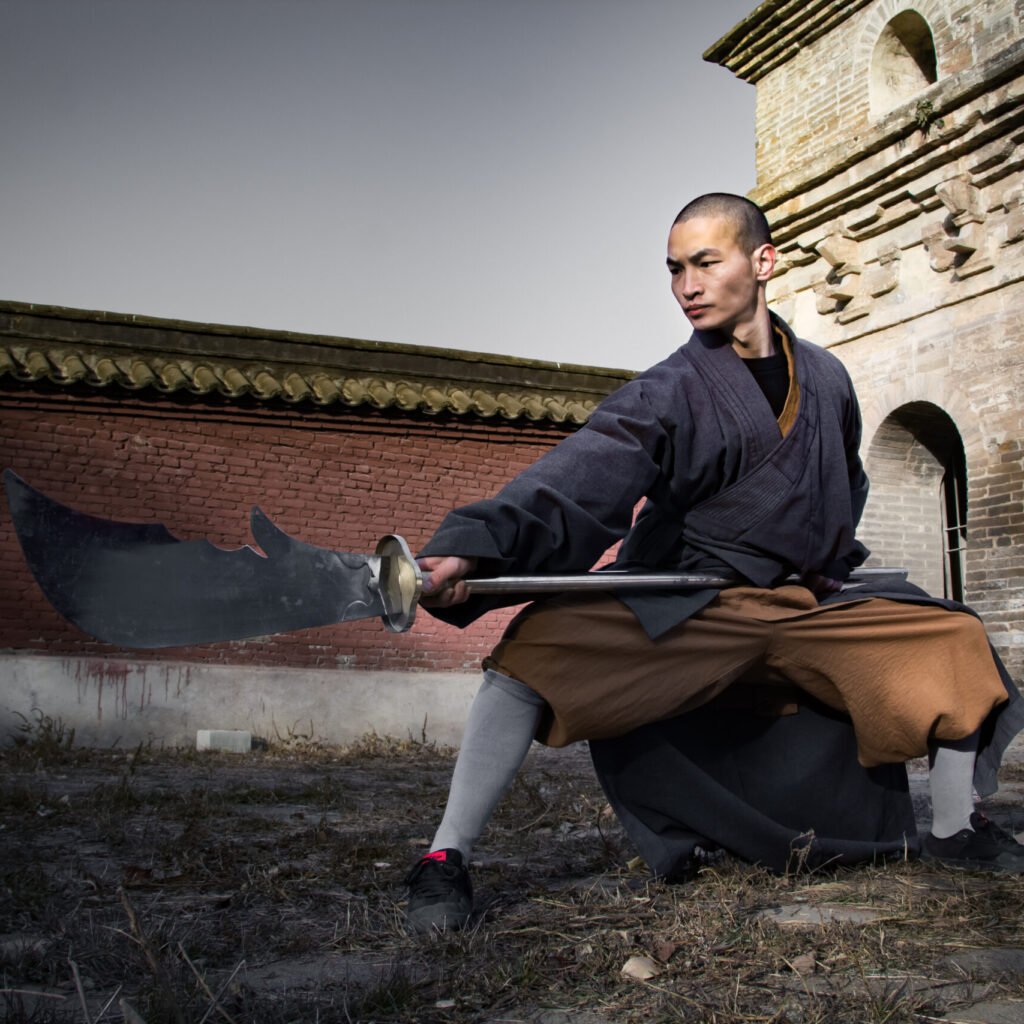
Shaolin Broadsword
The Shaolin Broadsword is a traditional long weapon in Shaolin Kung Fu. It features a wide blade, a heavy blade head, and an extended handle suitable for two-handed use. Its main techniques include striking, slashing, lifting, sweeping, blocking, and thrusting. The movements are powerful and intense, allowing both offensive and defensive applications. Because of its tremendous striking power, it has been honored later on with the title “Commander of All Weapons.”
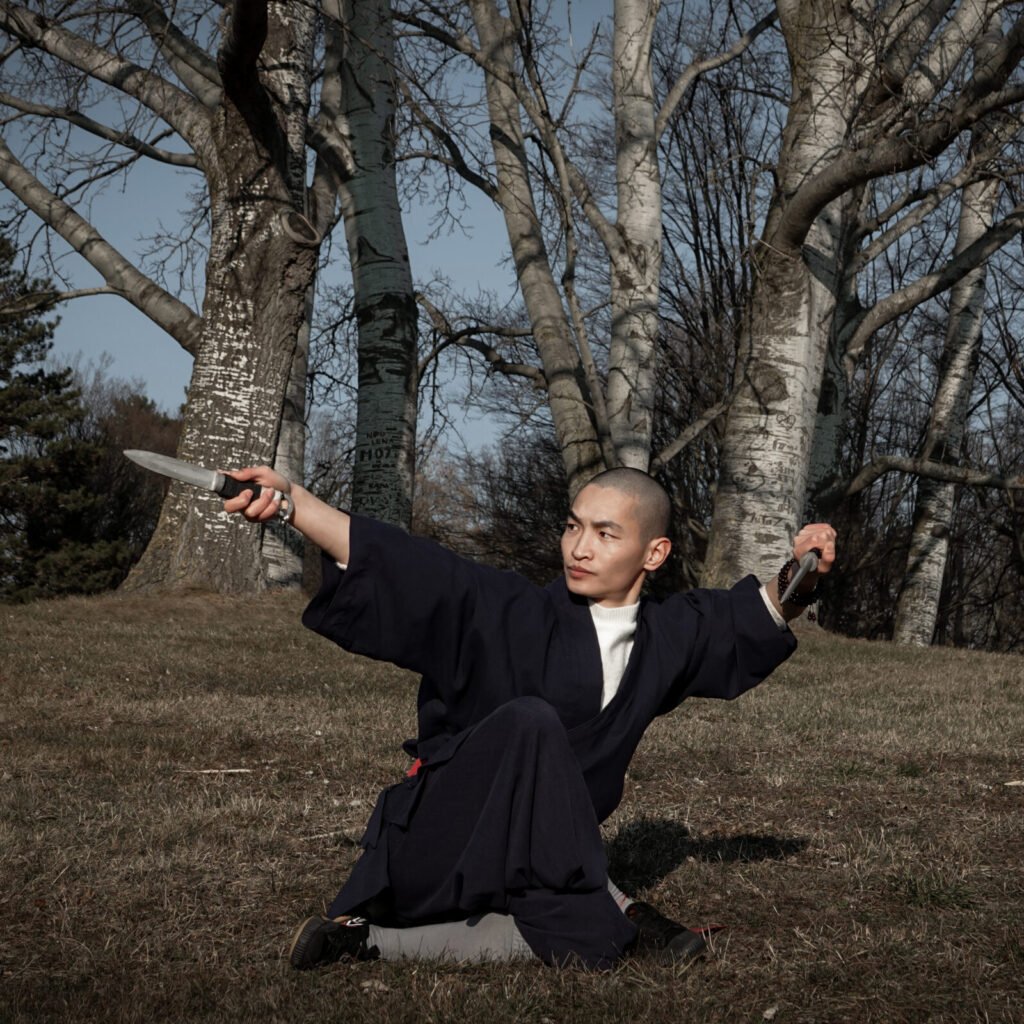
Shaolin Double Daggers
The Shaolin Double Daggers are a type of short weapon in traditional Shaolin Kung Fu, renowned for their agility, speed, and fierce stabbing techniques. Though small in size, the daggers have a extremely high striking power and are well-suited for close-combat and covert attacks. In Shaolin Kung Fu, the double daggers are combined with fist techniques, kicking methods, and grappling skills to form a unique offensive and defensive system.
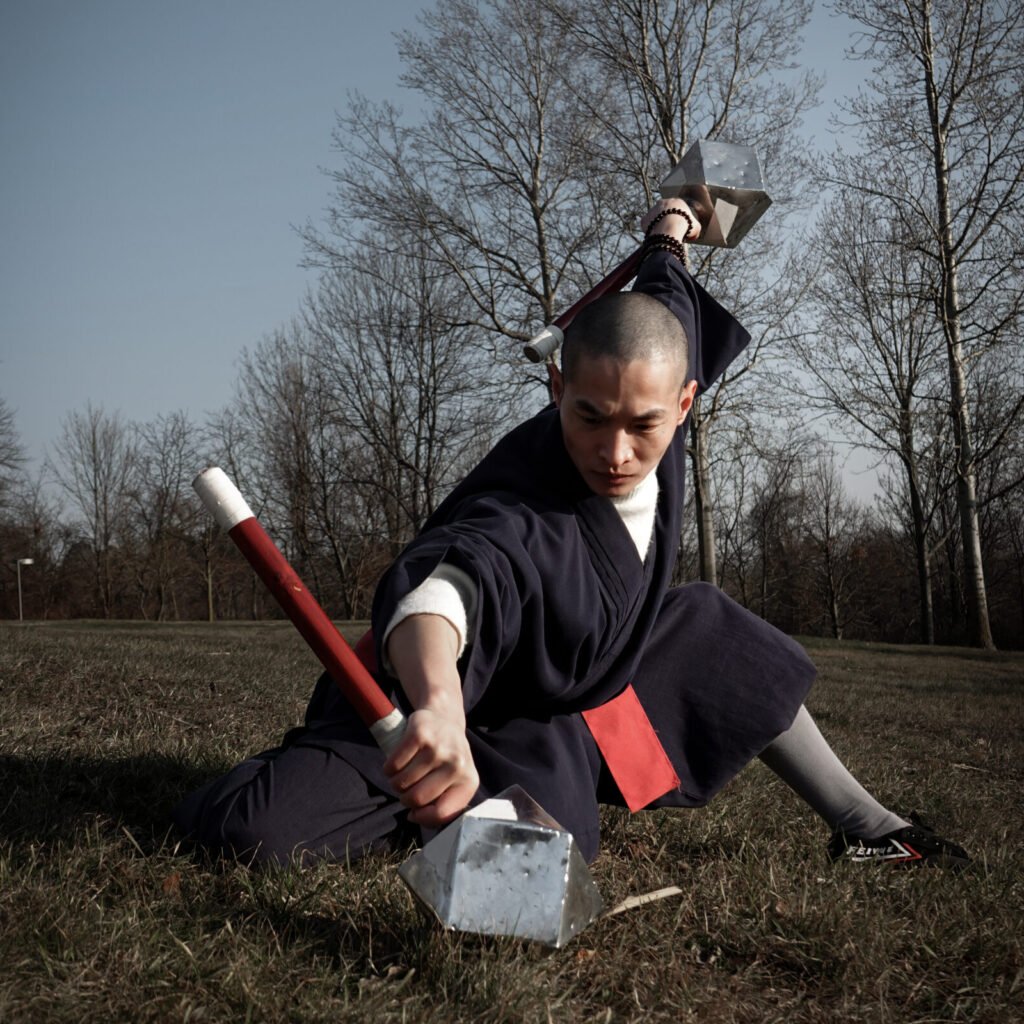
Shaolin Double Hammers
The Shaolin Double Hammers are a traditional weapon in Shaolin Kung Fu and belong to the short weapons. Each hand wields a hammer, with heads typically made of metal and varying in shape, e.g. round, or octagonal. The handles are relatively short, making them suitable for close-range combat. The primary techniques include smashing, sweeping, lifting, and blocking. The use of the double hammers requires great arm and wrist strength, as well as the skill of agile body movement and footwork. In ancient battlefields, the double hammers were widely used and, due to their tremendous destructive power, were praised as “armor-breaking weapons.”
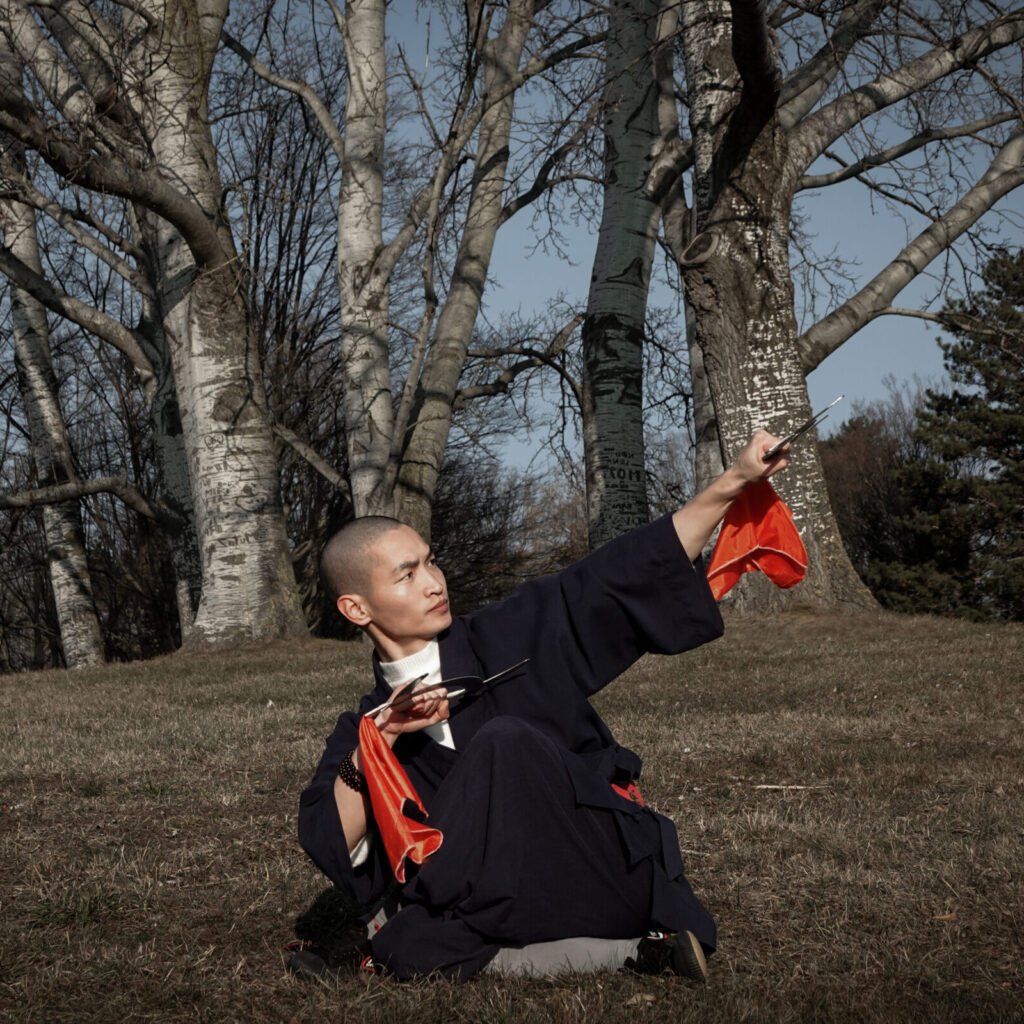
Shaolin Halfmoon Daggers
The Shaolin Halfmoon Daggers (lit. Mother-and-Child Axes) are a unique type of short double weapon within the Shaolin weapon-system. It consists of two parts: the larger “Mother Axe” and the smaller “Child Axe”. This weapon is primarily used for close-range combat and combines various techniques such as chopping, hooking, entangling, lifting, and thrusting. Its attacks are extremely flexible and diverse, making it one of the commonly used weapons by Shaolin monks for practical combat.
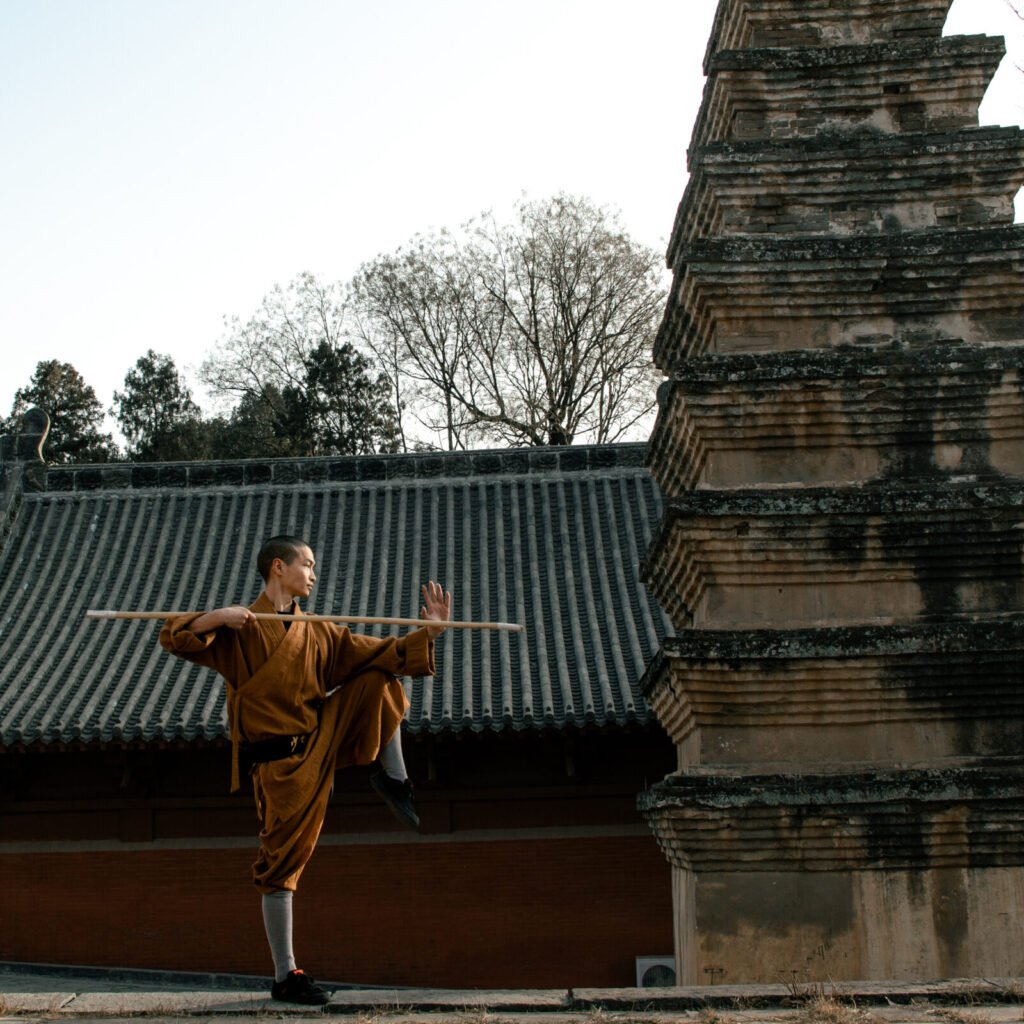
Shaolin Staff
The Shaolin staff is the most renowned weapon in Shaolin Kung Fu. Not only do the monks of the Shaolin Temple revere it as the “ancestor of all weapons,” but people from all walks of life honor the Shaolin staff as well. The staff techniques primarily include sweeping, deflecting, blocking, thrusting, lifting, striking, and jabbing. Training in staff techniques is intense, with a clear rhythm, and it requires speed, courage, and dynamic movements. Among the most famous forms are the “Yin Shou staff”, the “Fire staff”, and the “Kinnara staff”.
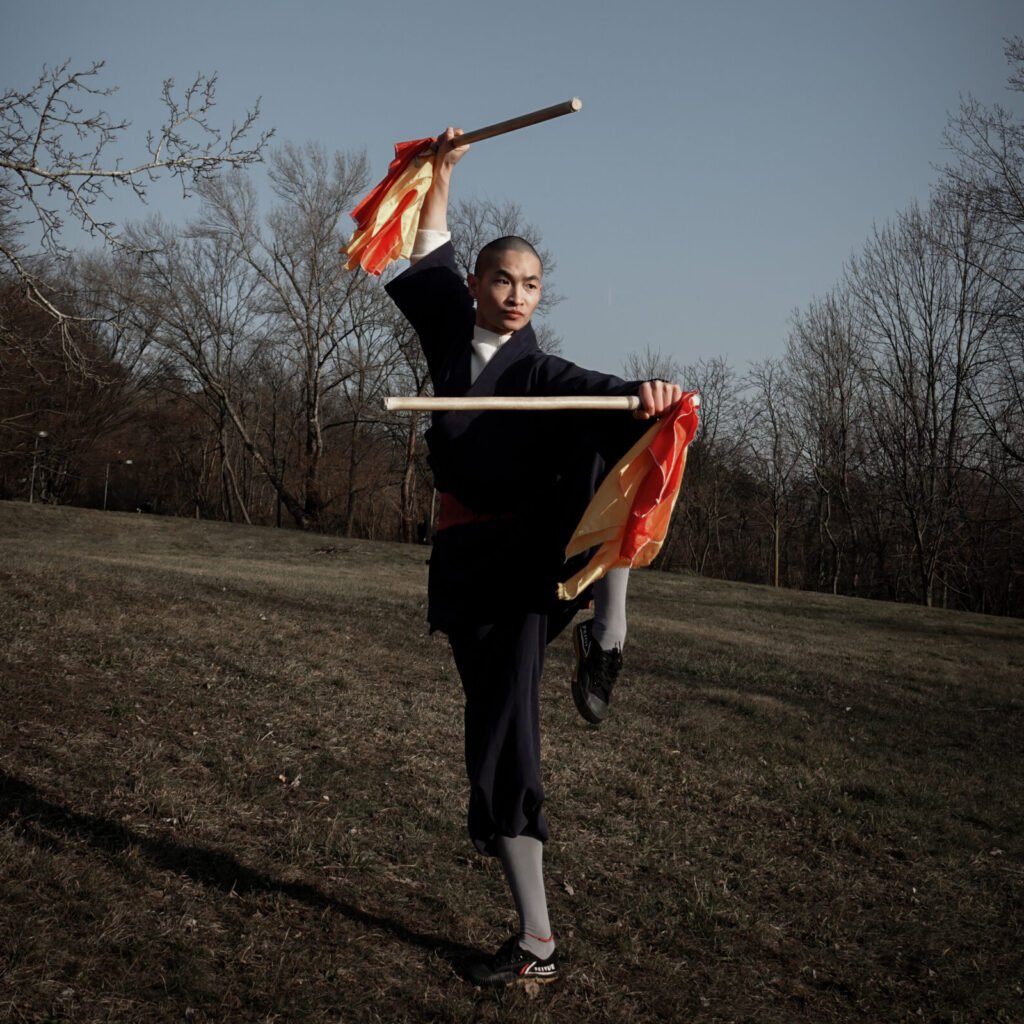
Shaolin Double Staffs
The Shaolin Double Staffs are a type of short weapon within the Shaolin weapon-system. They are known for their combination of offense and defense as well as their versatile techniques. Compared to the single staff, the double staffs offer greater flexibility and striking speed, allowing simultaneous attack and defense, making it difficult for opponents to counter and defend themselves. Through long-term combat experience and training, Shaolin monks integrated fist techniques, footwork, and body movements, out of which a unique weapon form was developed, making the double staff an important part of the Shaolin weapon-system.
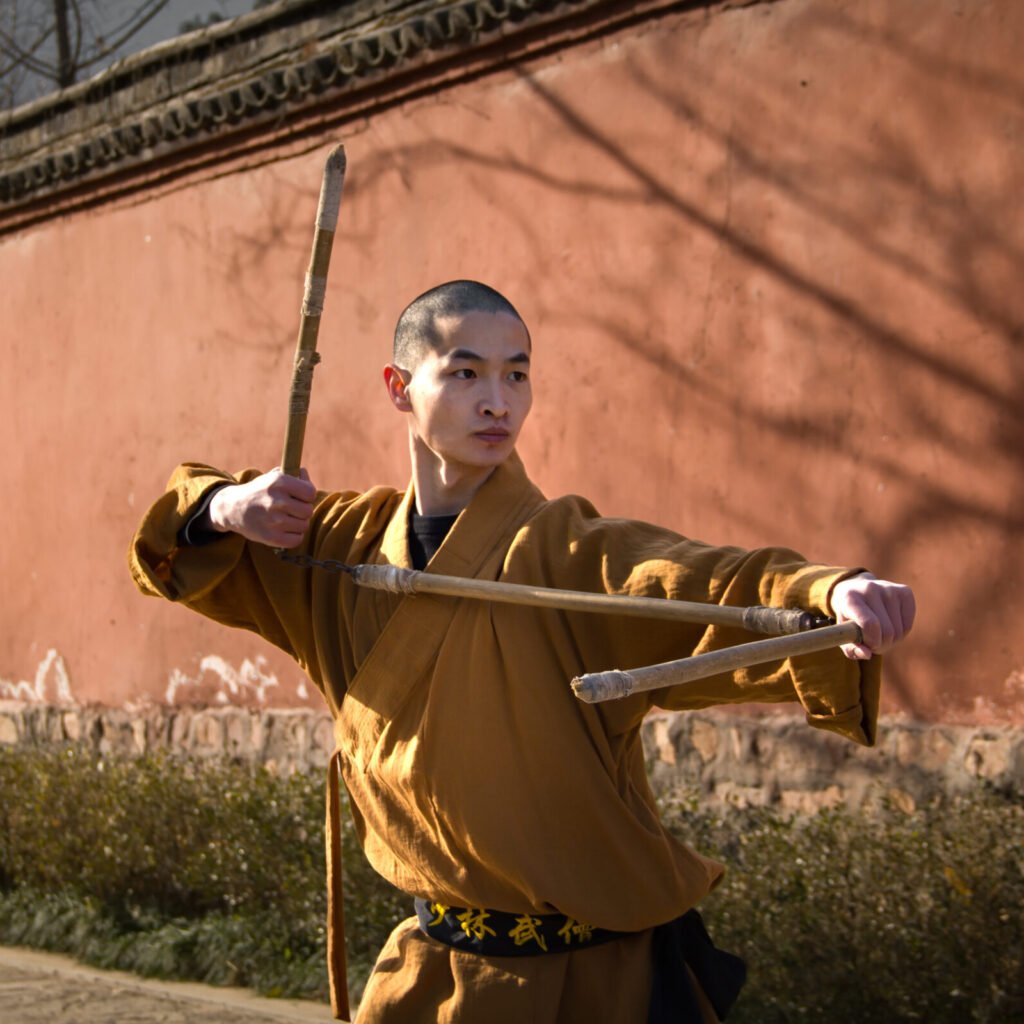
Shaolin Three-Section Staff
Shaolin Three-Section Staff belongs to the flexible weapons in the Shaolin weapon system. It is composed of three short staffs connected by iron chains or leather straps. It combines the characteristics of various weapons such as the staff, whip, hammer, and rope enabling both powerful slashing and flexible wrapping attacks. It offers a balanced combination of offense and defense and is praised as a classic weapon that employs both “soft and hard” tactics.
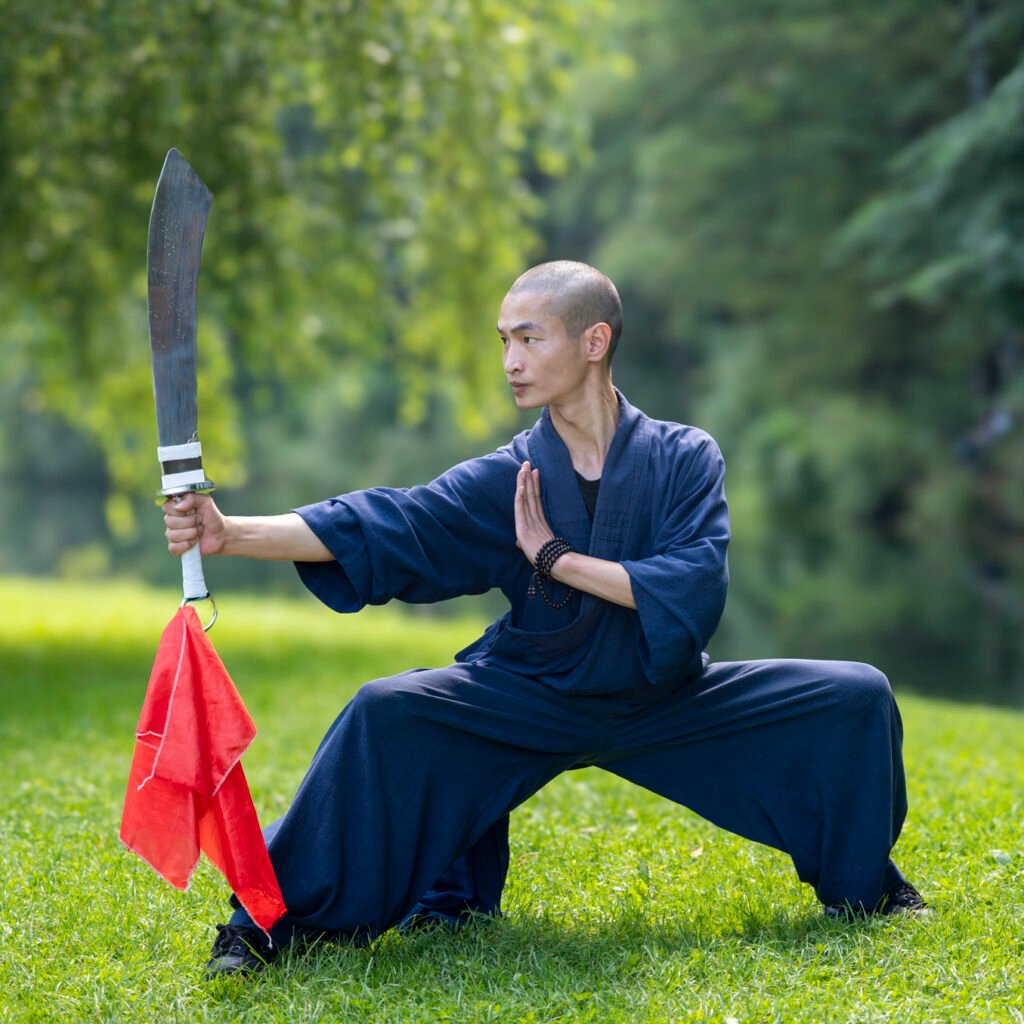
Shaolin Saber
The Shaolin saber was originally one of the most widely used weapons in both folk martial arts and the military. The Shaolin saber system began to take shape during the mid to late Ming Dynasty. By the end of the Ming Dynasty, as Shaolin Kung Fu developed and warrior monks took part in battles, the saber became one of their most frequently used weapons by the Shaolin warrior monks.
The system’s techniques include wrapping and circling motions around the head, combined with turning slashes and sweeping strikes, as well as thrusting, lifting, chopping, blocking, and throwing — together forming a complete saber-fighting system. After the Qing Dynasty, the number of Shaolin saber forms increased, and the techniques were further refined. There is a saying that “The Shaolin saber is like a fierce tiger,” describing the weapon’s powerful and brave nature when wielded in combat.
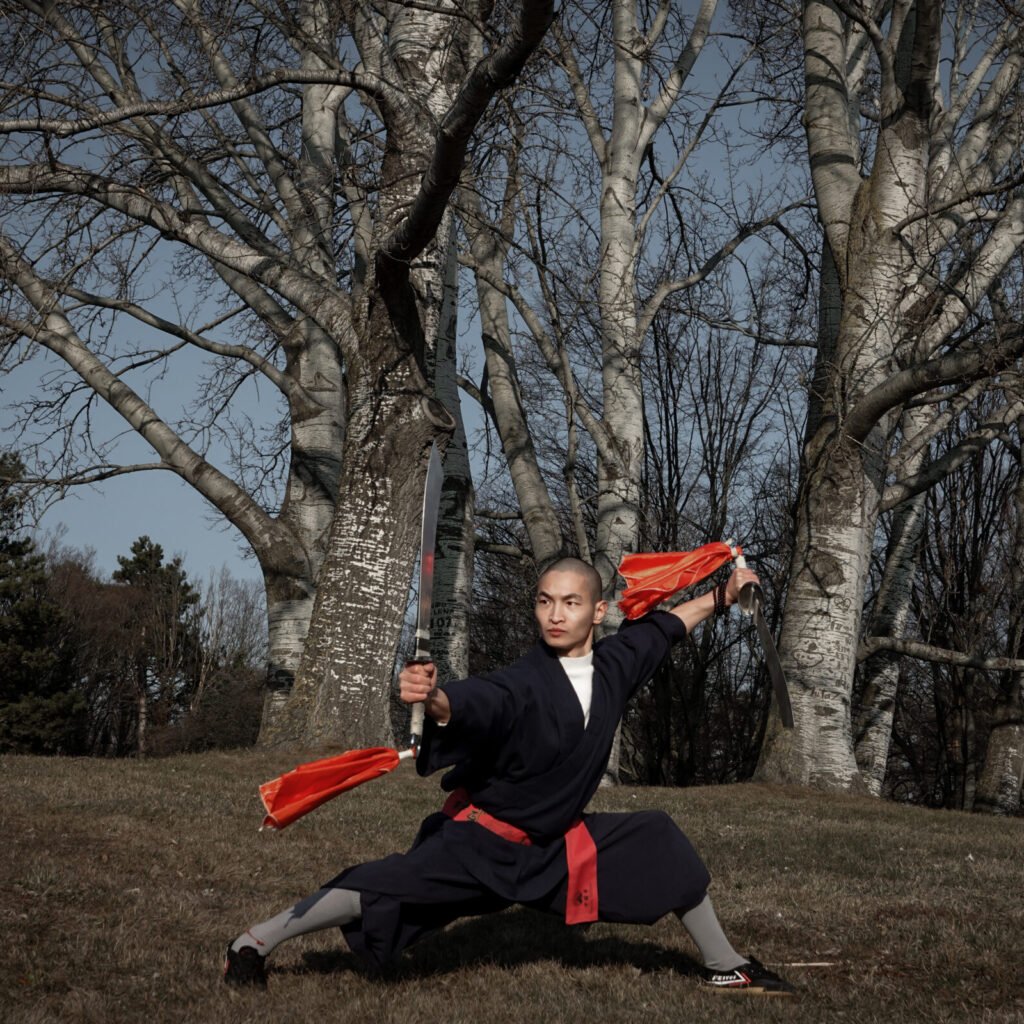
Shaolin Double Sabers
The Shaolin Double Sabers are a dual-weapon technique within the Shaolin weapon system. They inherit the methods of the single saber while enhancing both attack frequency and defensive capability, making them more dynamic and unpredictable in combat. The form emphasizes coordination between both hands, complementarity between left and right, agile footwork, and rapid attack combinations. Its techniques are characterized by being as “swift as the wind, fierce as the tiger, and powerful as thunder.”
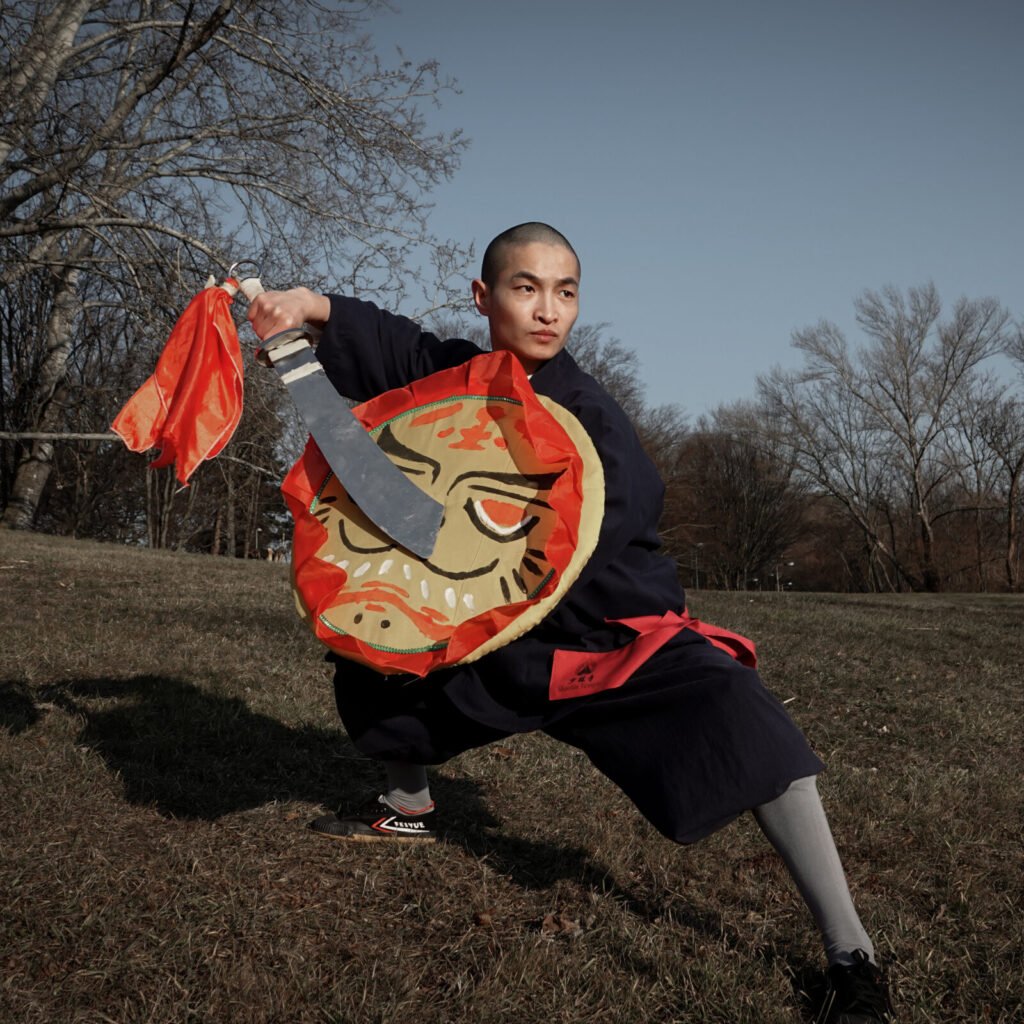
Shaolin Shield-Saber
The Shaolin shield and saber technique can be traced back to the Ming Dynasty during times of warfare, when Shaolin monks were recruited by the imperial Ming regime to help repel invaders. The invaders often wielded Katana swords and attacked with great speed and ferocity. To counter these aggressive assaults, the Shaolin warrior monks developed a combat method that combined the use of a shield and a saber. The Shaolin shield and saber is a unique weapon combination that integrates both defense and offense. The shield is used for blocking and controlling the opponent, while the saber delivers rapid counterattacks. This makes it difficult for the enemy to break through the line of defense while simultaneously being confronted with fast attacks when he tries to counter.
Shaolin Sword
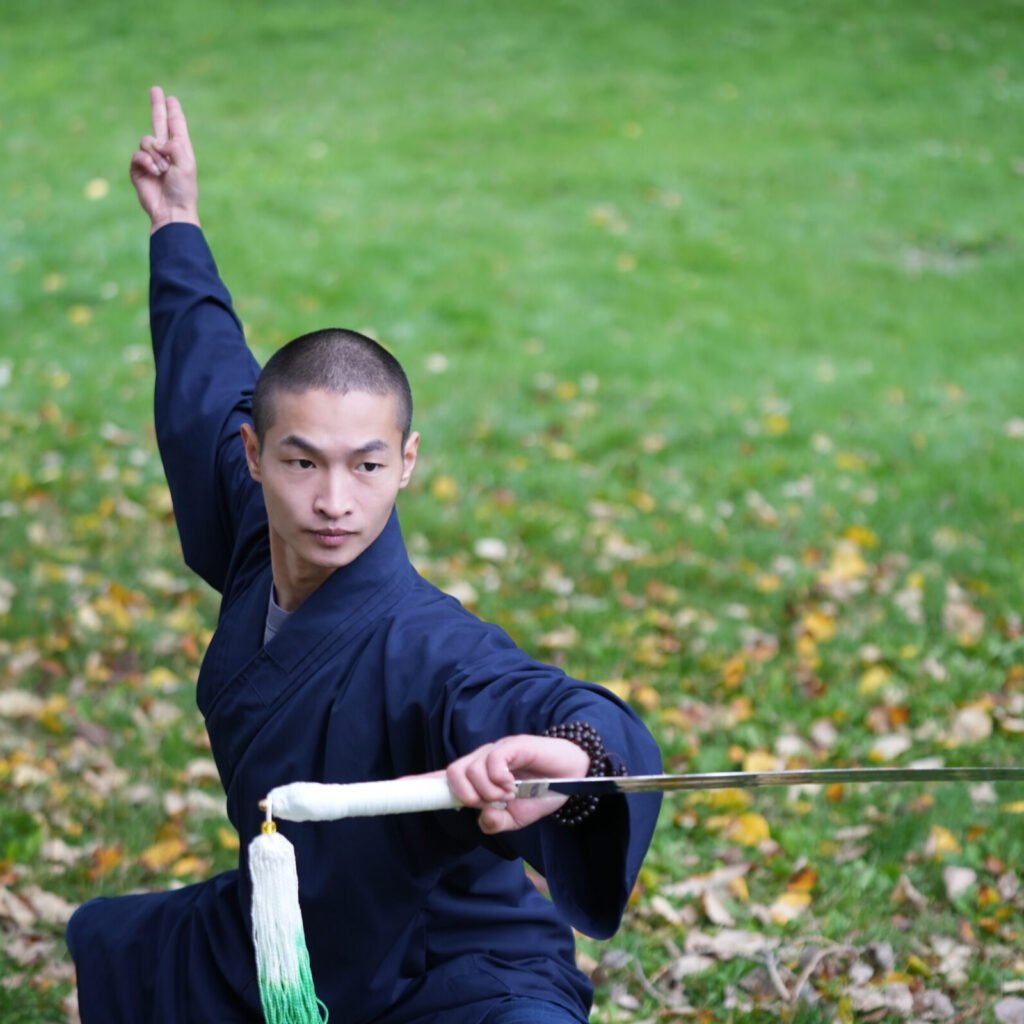
The Shaolin sword is one of the weapons most frequently used by Shaolin monks and is among the most representative of the traditional Eighteen Shaolin Weapons. It is characterized by a balance of hardness and softness, lightness and agility, and the makes use of the skill to overcome brute strength with finesse. Unlike the saber, which emphasizes power and ferocity, Shaolin sword techniques focus on the coordination of body and footwork, highlighting circular and fluid movements and the combination of real and feigned attacks. The sword follows the body, and the body follows the mind. This weapon emphasizes flexibility and adaptability by controlling the raw strength of the opponent with small and dynamic attacks. The sword techniques include both swift jabs and elegant spinning slashes, agile steps and body movement to create more deceptive and highly variable attacks.
Shaolin Double Swords
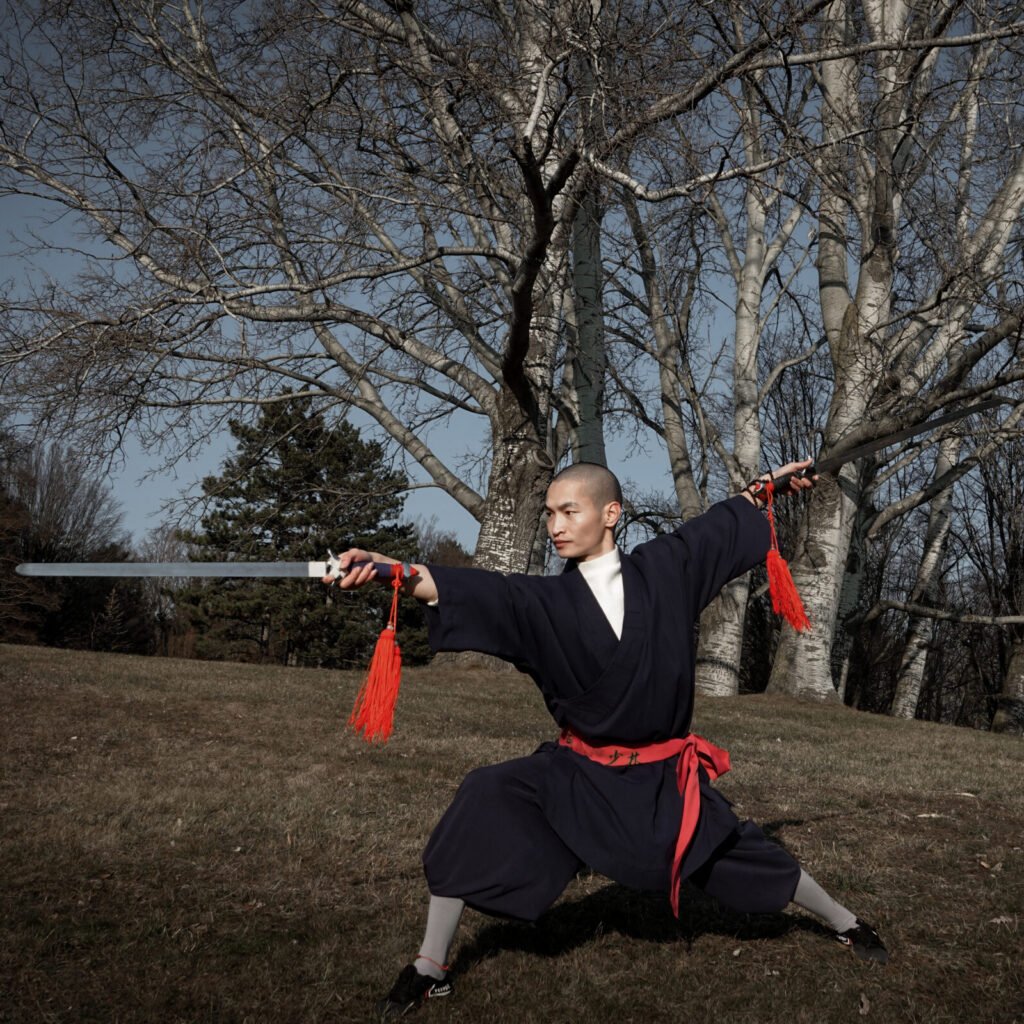
The Shaolin Double Swords are a dual-weapon technique within the Shaolin weapon system. Based on the fundamentals of single sword techniques, the double swords form additionally and especially emphasizes the coordinated use of both hands, connecting offense and defense. One sword is used for attacking while the other defends, switching rapidly to form a fluid system of offense and defense. In battle, the Shaolin Double Swords emphasize the unity of body and sword, with fast attacks and quick defenses. The agile footwork combined with continuous attacks with both swords makes it difficult for the opponent to find weaknesses in the attacks.
Shaolin Crescent Spade
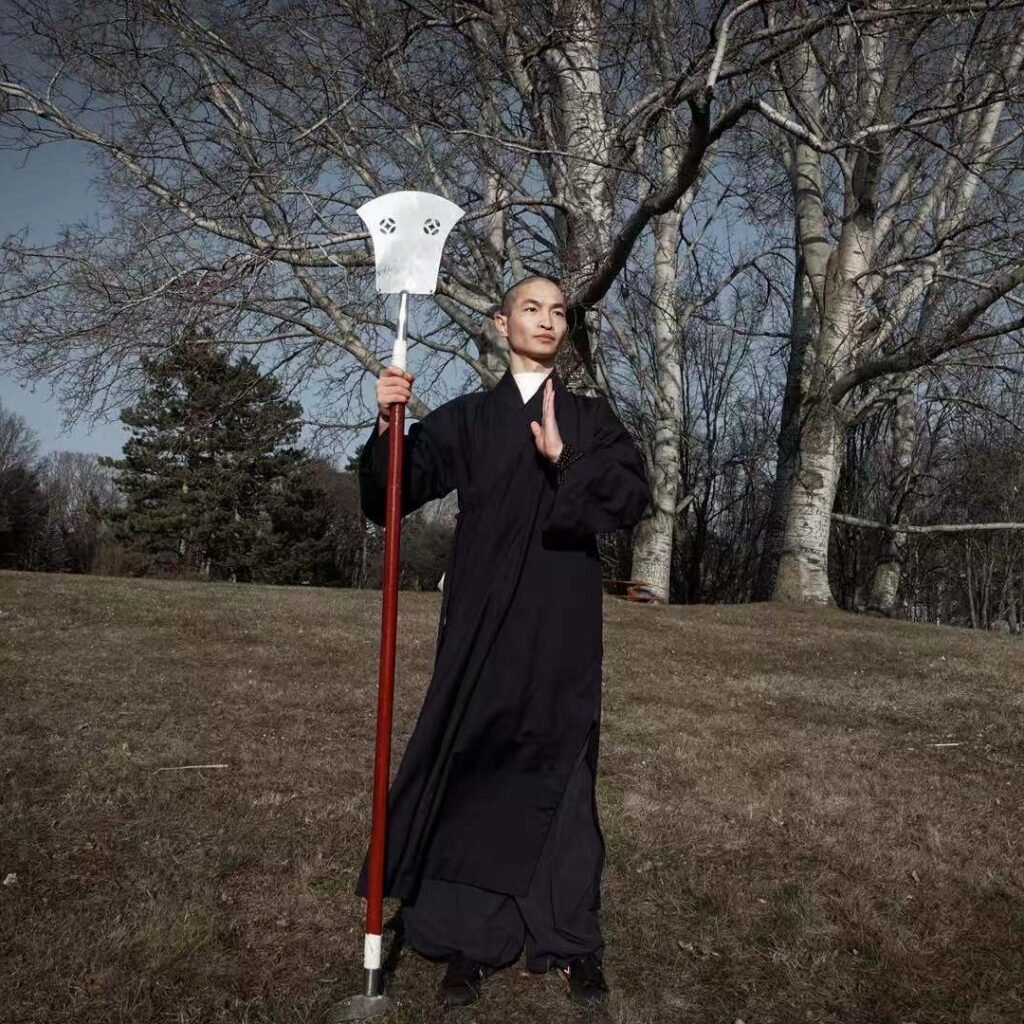
The Shaolin Crescent Spade belongs to the category of long weapons. According to the Shaolin Weapon Manual, during the Yuan Dynasty, Monk Huiju was a Master in wielding the spade. He often practiced with it in the deep quiet of the night, using movements of Shaolin Kung Fu. On several occasions, when thieves attempted to scale the monastery walls and rob the temple, he used the spade to defend himself and successfully repelled the attackers each time. Afterwards, he recorded the combat techniques used in these encounters, developing them into a complete form that was passed down through generations and greatly admired among Shaolin monks. The techniques of the Crescent Spade include striking, lifting, hooking, jabbing, sweeping, and spinning. These are combined with techniques from the Shaolin spear, staff, and saber, forming a distinctive combat system.
Shaolin Nine-Section Whip
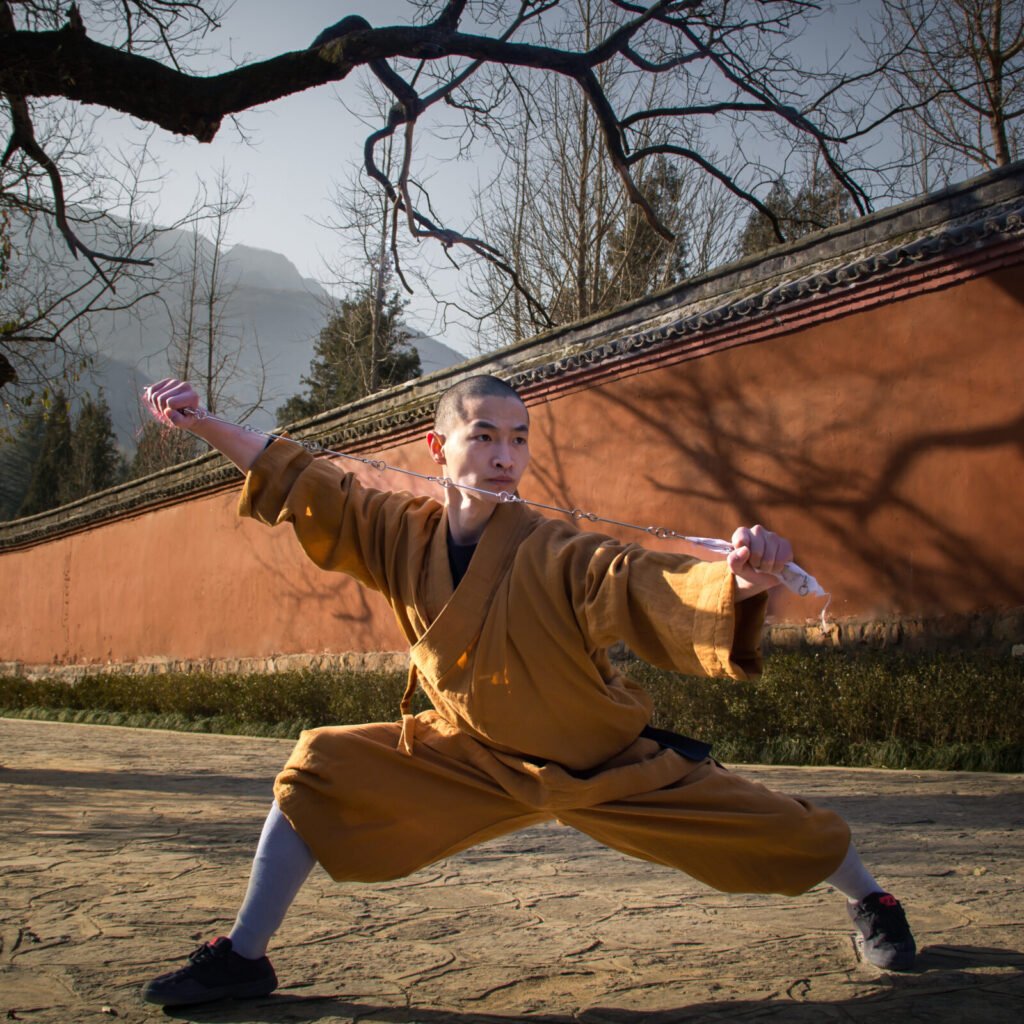
The Shaolin Nine-Section Whip approximately originated during the Song Dynasty. According to the „Shaolin Quanpu“, during that period, the eminent monk Fu Ju of Shaolin Temple sought to develop Shaolin martial arts and improve the fighting skills of Shaolin monks. He invited eighteen martial arts masters from across the country to Mount Song’s Shaolin Temple to exchange their knowledge, and it was during this time that the Nine-Section Whip was introduced to the Shaolin Temple.
Through study and practice by Shaolin monks over centuries, it gradually evolved into a distinctive and highly practical weapon within the Shaolin weapon system. Its fundamental techniques include swinging the whip to strike the opponent’s face, sweeping the whip to attack and disrupt the opponent’s lower body, and entangling the whip by using its flexible body to wrap around the opponent’s weapon or limbs, throwing them off balance. It also includes spinning attacks, which are wide rotational motions that generate great destructive force, and lastly binding techniques that trap the opponent’s weapon or body, preventing any counterattack.
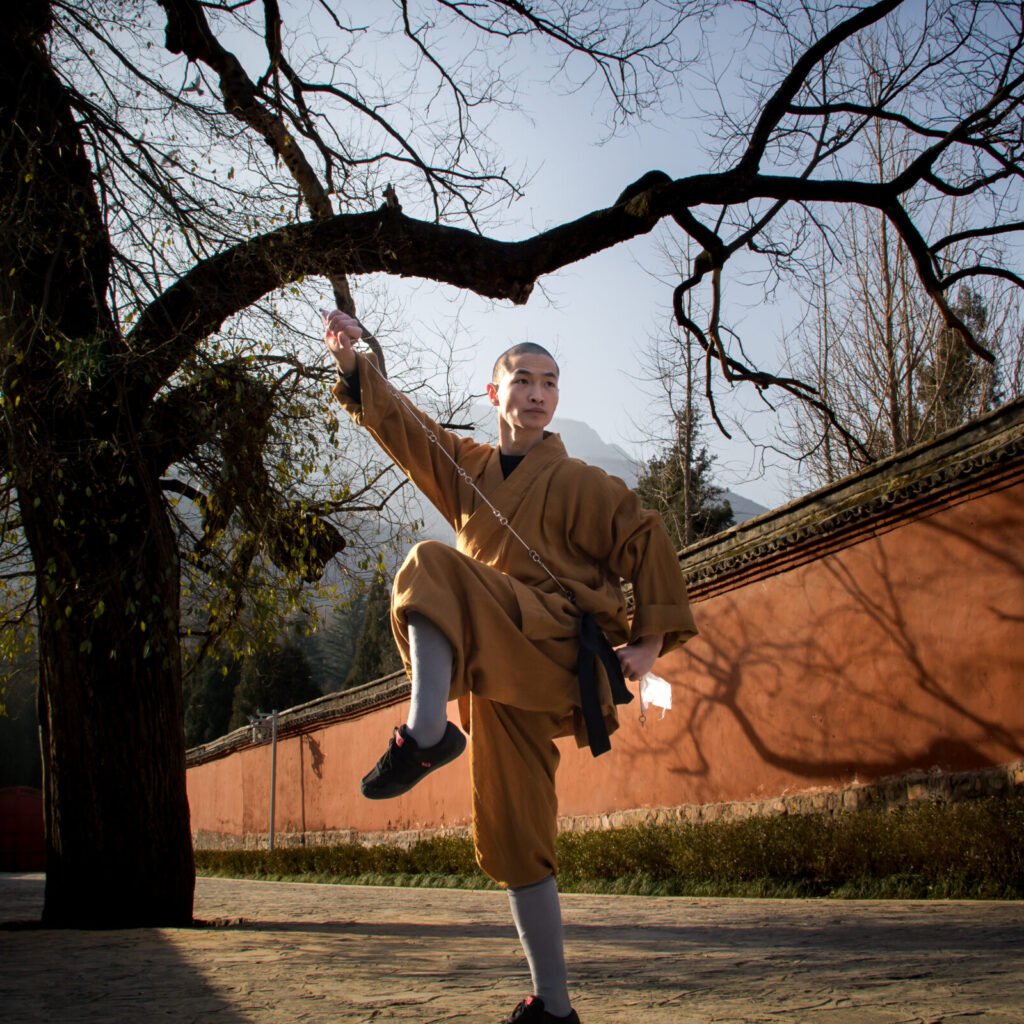
Shaolin Double Nine-Section Whip
The Shaolin Double Nine-Section Whip is an advanced weapon technique within the Shaolin whip system. It is based on the single Nine-Section Whip and also includes skills such as swinging the whip to strike the opponent’s face, sweeping the whip to attack and destabilize the opponent’s lower body, entangling the whip to wrap around the opponent’s weapon or body and throw them off balance, spinning the whip in wide, circular attacks that generate great destructive force, and binding the whip to trap the opponent’s weapon or body, preventing counterattacks. Compared to the single Nine-Section Whip, the use of the double version is significantly more difficult, requiring a high degree of coordination between both hands.
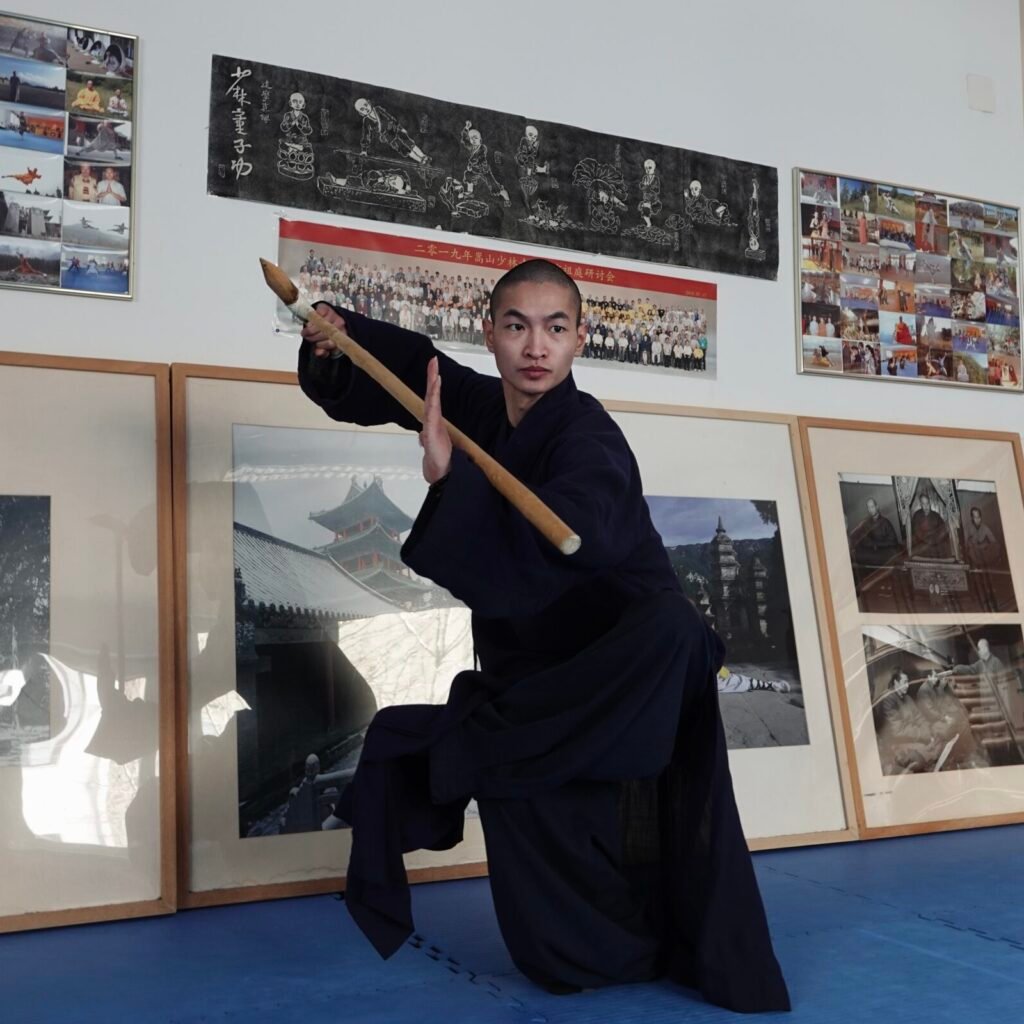
Shaolin Da Mo Staff
The Shaolin Da Mo Staff (crutch) is a unique short weapon, shorter than the standard staff. It is known for its compact size, agility, practicality, and versatility in both offense and defense, making it especially effective in close combat. Its techniques are derived from traditional Shaolin staff methods, with core movements including striking, sweeping, jabbing, thrusting, hooking, and pressing. The Shaolin Da Mo staff is a highly practical weapon for self-defense.
Do you have questions?
If you have any questions or want to book a lesson, feel free to contact me!
Do you have questions?
If you have any questions or want to book a lesson, feel free to contact me!